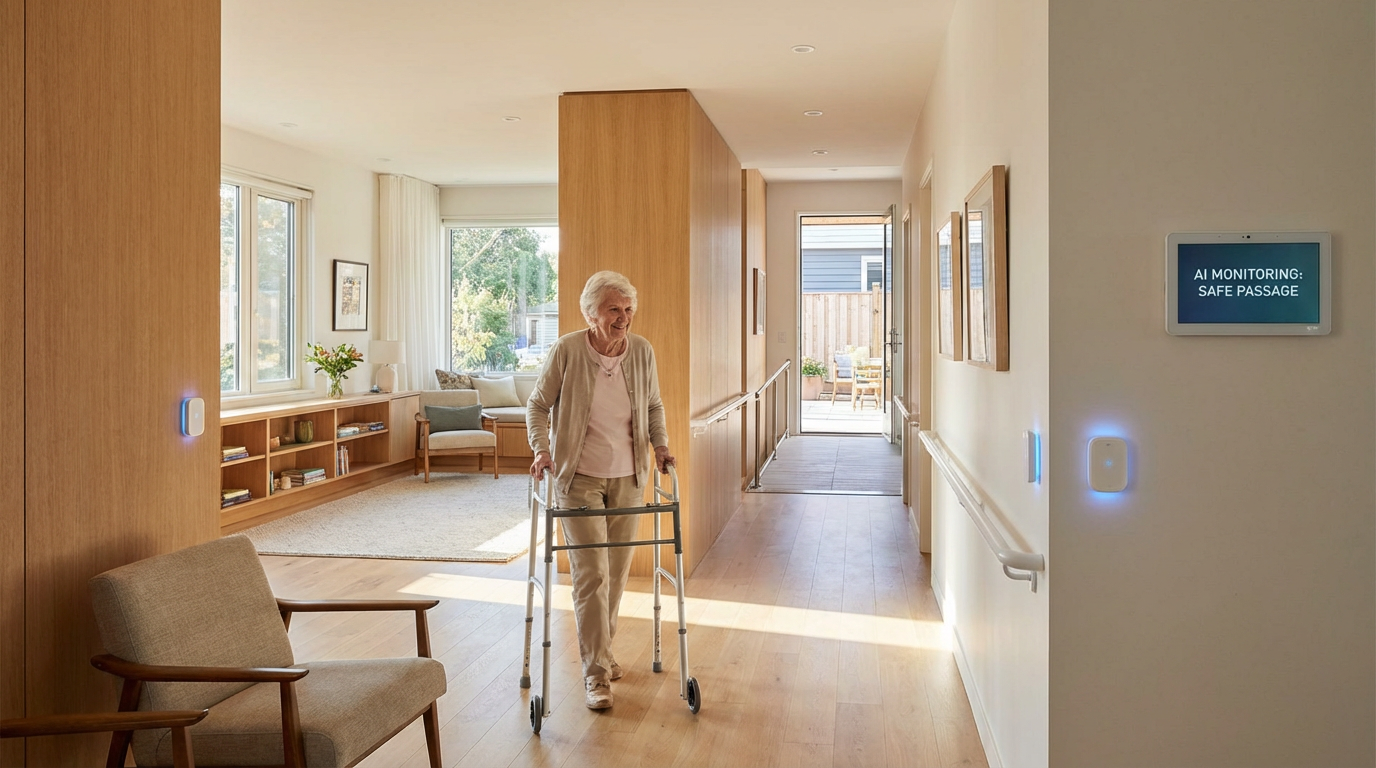
Denise Jeter broke her back in 2019. Not in a car wreck or a fall from scaffolding — she slipped on wet tile stepping out of the shower in the house she’d owned for eleven years. The spinal cord injury left her in a wheelchair. The house she’d paid off became a prison. Doorways too narrow. Bathroom unusable. Kitchen counters eighteen inches too high. She spent nine months in a nursing facility — at $9,200 a month — while contractors widened her hallways and gutted both bathrooms. Total renovation cost: $87,000.
Had that house been built with 36-inch doorways instead of 32, a curbless shower instead of a tub, and blocking in the bathroom walls for future grab bars, the cost at construction would have been roughly $1,200 more. That’s 1.4% of what Denise actually paid.
The Math Nobody Wants to Do
The United States has approximately 140 million housing units. By the most generous estimates, about 3.5% are wheelchair accessible — meaning they have at minimum a no-step entry, one accessible bathroom, and hallways wide enough for a chair. The American Housing Survey, conducted by the Census Bureau, puts it lower: roughly 3.1% when you include single-family, multifamily, and manufactured housing.
Meanwhile, 61 million adults report a disability. Thirteen million have a mobility disability specifically. The gap between supply and demand isn’t a crack. It’s a canyon.
And it widens every year. America builds about 1.4 million new housing units annually (Census Bureau, 2024). Almost none are built to even basic visitability standards. The Fair Housing Act requires accessibility features in multifamily buildings with four or more units — but it exempts single-family homes entirely. If you’re building a house from scratch with private financing, you can make every doorway 28 inches wide and there’s not a thing any federal agency can do about it.
Visitability: The Three Things That Cost Almost Nothing
The visitability movement, championed by disability rights activist Eleanor Smith since the 1980s, asks for three modifications to new construction:
One. At least one zero-step entrance. Cost at construction: $100–$600 (grading adjustment). Cost to retrofit: $1,500–$8,000 (ramp or lift).
Two. All interior doors on the main floor at 32 inches clear (34-inch frame). Cost at construction: $0–$200 total (wider frames, same labor). Cost to retrofit: $500–$1,500 per doorway (reframe, move studs, patch drywall, repaint).
Three. One accessible half-bath on the main floor. Cost at construction: $200–$400 (wider footprint, blocking for grab bars). Cost to retrofit: $5,000–$15,000 (demolition, replumbing, rebuild).
Total premium for visitability in new construction: roughly $500–$1,200 on a $350,000 house. That’s 0.14%–0.34% of the build cost. Roughly the cost of upgrading your cabinet hardware.
What AI Actually Changes
Accessibility in floor plans used to be a specialization. You needed an architect who understood ADA turning radii (60 inches for a full wheelchair turn), approach clearances at doors (18 inches on the pull side, 12 on the push), and the cascading dimensional implications — a wider hallway here means a smaller closet there means a shifted plumbing stack.
Maket AI dissolves that expertise barrier. Its generative floor plan engine accepts accessibility constraints as inputs — wheelchair turning radii, zero-threshold entries, grab bar placement zones, minimum hallway widths — and produces compliant layouts in seconds. Hundreds of variations. Each one respecting the spatial math that a human designer might spend days on.
This matters because the standard builder objection to accessibility isn’t cost. (The numbers above demolish that argument.) It’s design effort. Accessible layouts feel unfamiliar. Builders don’t stock plans that include them. Architects charge extra to think about them. The result is that accessibility gets “value-engineered” out of every project that doesn’t have a current wheelchair user as the client.
AI plan generators eliminate that friction. If every stock plan in the builder’s catalog already meets visitability requirements because the generator was constrained to produce them, the “extra effort” argument dies.
“The cost of universal design at construction is 1–3% of the build. The cost of retrofitting is 10 to 30 times that. Every home we build without basic accessibility is a future demolition project.”
— Center for Inclusive Design and Environmental Access, University at Buffalo
The Legislative Patchwork
Only a handful of jurisdictions mandate visitability in new single-family construction. Pima County, Arizona was the first, passing an ordinance in 2002. Atlanta followed in 2005 — Eleanor Smith’s hometown, not coincidentally. A few cities in Texas and Illinois have partial requirements. Vermont offers tax credits for accessible features but doesn’t mandate them.
The Fair Housing Act’s design and construction requirements (Section 804(f)(3)) apply only to multifamily housing with four or more units built after March 1991. Single-family homes and duplexes are entirely exempt. The ADA applies to commercial and public accommodations — not private residences. There is no federal visitability mandate for new single-family homes. Period.
Bills have been introduced. The Eleanor Smith Inclusive Home Design Act has been proposed in multiple congressional sessions. It would require basic visitability features in all new federally assisted housing. It has never made it out of committee.
The political reality: homebuilders lobby aggressively against any mandate that adds cost, even $500. NAHB has opposed every federal visitability proposal, arguing that market forces should drive accessibility adoption. The market has had forty years. It produced a 3% accessible rate.
The Retrofit Trap
Without mandates, America is stuck in what disability advocates call the retrofit trap: we build inaccessible homes cheaply, then spend orders of magnitude more adapting them after someone gets injured, ages into disability, or has a child with mobility limitations.
The math at national scale is staggering. An estimated $40–60 billion is spent annually on home accessibility modifications in the United States (combining HUD CHAS data, Medicare home health expenditures, and private renovation estimates). Had those homes been built with basic visitability — at roughly $800 per unit — the cost for all 1.4 million annual housing starts would be $1.12 billion. We are spending 40–50 times more to fix what we refuse to prevent.
Beyond the Chair
The narrow framing of accessibility as “wheelchair stuff” has always been the movement’s political weakness. Universal design benefits everyone who will ever be temporarily injured, push a stroller, carry groceries, age past 70, or host a grandparent for Thanksgiving.
Wider hallways are better hallways. Lever handles work when your hands are full. Curbless showers are easier to clean. Zero-step entries don’t trip anyone. The design changes that serve wheelchair users also produce homes that are simply more functional for the other 97% of the population.
AI design tools don’t distinguish between “accessible” and “good.” When Maket AI generates a floor plan with 36-inch hallways and curbless bathrooms, the output doesn’t look institutional. It looks modern. Generous. Open. The stigma that plagued accessible design for decades — the handrails and clinical tile and nursing-home aesthetic — vanishes when the AI optimizes for both compliance and beauty simultaneously.
What This Means If You’re Building
Demand visitability from your builder. Zero-step entry, 34-inch door frames, main-floor half-bath with blocking. If they quote you more than $1,200 for these features in new construction, they’re either uninformed or padding the bid.
Run your plan through Maket AI. Even if you’re working with an architect, generating accessible variations takes seconds and costs nothing. It gives you a comparison baseline.
Install blocking everywhere. $20 worth of plywood behind bathroom drywall means a grab bar can go in with four screws instead of a $2,000 renovation. Do it in every bathroom, next to every toilet, and in the shower surround. Future-you — or future-buyer — will be grateful.
There are 61 million Americans with disabilities. By 2060, there will be 95 million people over 65. The homes going up this year will still be standing when those numbers peak. AI can make accessible design trivially cheap and effortlessly beautiful. What it cannot do is make builders choose it — or make legislators require it. That part is still on us.