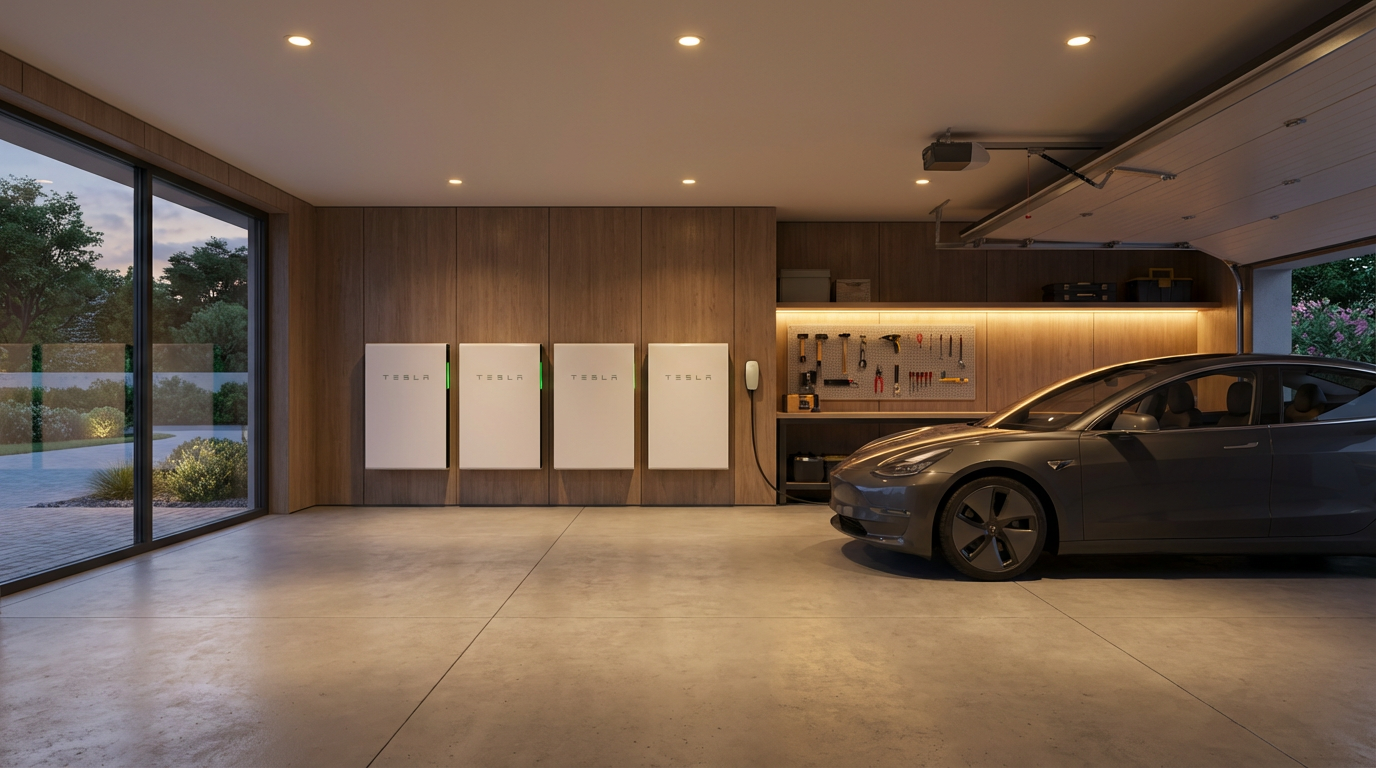
The installer quoted her two Powerwalls. Thirteen kilowatt-hours each, $14,200 installed after the federal tax credit. A Phoenix homeowner with a 9.6 kW solar array, a Level 2 EV charger, and a utility rate that spikes to $0.24/kWh between 3 and 8 p.m. She signed the contract. Six months later, she discovered something mildly infuriating: one Powerwall would have covered 94% of her peak-shaving needs. The second sits at 80% charge most evenings, cycling so shallowly it barely justifies the degradation.
She overspent by roughly $7,000. And she’s not unusual.
The Sizing Problem Nobody Talks About
The residential battery storage market hit $6.85 billion globally in 2025 and is projected to reach $32.36 billion by 2034, growing at 17.8% CAGR, according to Fortune Business Insights. That surge is driven by real economics: time-of-use rate arbitrage, backup power demand after climate disasters, and a 30% federal tax credit that makes the math close enough to tempt anyone already signing a solar contract.
But the math only closes if you buy the right amount of storage. And right now, most homeowners are guessing.
Battery sizing depends on a tangle of variables that interact in non-obvious ways: your solar production curve (which shifts monthly), your consumption profile (which shifts hourly), your utility’s rate structure (which may have changed since your last bill), your EV charging habits, whether you care more about backup autonomy or daily bill savings, and the export rate your utility pays for surplus generation. A human installer with a spreadsheet can approximate this. An algorithm running 8,760-hour simulations against your actual interval meter data can optimize it.
At $800–$1,200 per kilowatt-hour installed before the tax credit — or $8,000–$16,000 for a typical residential system, per VeCharged’s 2025 US Home Energy Report — every kilowatt-hour of oversizing is real money parked in your garage doing nothing. Every kilowatt-hour of undersizing is revenue you’re leaving on the table.
What AI Sizing Actually Looks Like
Savant Power represents the high end of intelligent home energy management: circuit-level monitoring, solar and battery orchestration, dynamic load prioritization during outages, and TOU rate optimization that adapts as utility tariffs change. The system learns your household’s consumption patterns — when the dryer runs, when the EV plugs in, how the HVAC load shifts with seasons — and adjusts battery dispatch strategies accordingly. It doesn’t just store energy. It decides when to store, when to discharge, and what to power.
Tesla’s Powerwall 3 runs its own ML-driven energy management layer. The algorithm ingests weather forecasts, your historical usage, your solar production, and your utility rate schedule to determine charge and discharge timing. In self-powered mode, it holds enough charge for overnight consumption while exporting surplus to maximize net metering credits. In time-of-use mode, it charges from solar during cheap midday hours and discharges during the evening peak — a spread that can be worth $0.15–$0.20/kWh in markets like California’s NEM 3.0.
The real innovation isn’t any single algorithm. It’s that the sizing question has shifted from a one-time sales calculation to a continuous optimization problem. A battery system with good software compensates for imperfect initial sizing by maximizing the value of whatever capacity you have.
Your Battery Can Earn Money. If It’s Big Enough.
Virtual power plants changed the economics of residential batteries from “insurance against outages” to “revenue-generating grid asset.” Ohm Analytics reports that residential VPP enrollments grew 153% year-over-year in 2025, contributing to 38 GW of total cumulative enrolled VPP capacity nationwide. The residential sector — batteries, smart thermostats, managed EV charging — now accounts for roughly a third of all VPP capacity and could overtake the commercial and industrial sector by 2028 at current growth rates.
Tesla paid Powerwall owners $9.9 million in 2024 for grid support during peak demand, according to Tesla’s VPP program disclosures. The PG&E program pays $2 per kWh discharged during grid emergencies, with homeowners earning $10–$60 per event. Some participants report several hundred dollars per year in passive VPP income. Green Mountain Power in Vermont offers Powerwall leases at $55/month with grid services credits that effectively make the battery free.
This is where sizing gets strategic. A battery sized only for self-consumption might leave no spare capacity for VPP dispatch. An AI-optimized system accounts for VPP revenue in the sizing calculation itself — potentially justifying a larger battery whose extra capacity pays for itself through grid services rather than direct bill savings.
New Construction Has a $4,000 Advantage
Here’s a number that should matter to anyone building a house: pre-wiring for battery storage during rough-in costs $400–$800. Running the same conduit, subpanel, and monitoring connections as a retrofit costs $2,000–$4,500. The same pattern we see with smart water monitoring, EV charging, and solar — infrastructure installed at framing is three to five times cheaper than infrastructure added later.
Builders who install battery-ready electrical infrastructure — dedicated subpanel, conduit from the panel to the garage or utility room, 240V circuit, network drop — give buyers the option to add storage at move-in or five years later without tearing open walls. In California, where NEM 3.0 has gutted solar export credits and made battery storage nearly mandatory for economic viability, some production builders now include a battery as standard, sized by the same energy modeling software that optimizes the HVAC system.
Where the Algorithms Fail
Sizing tools are only as good as their inputs. If your interval meter data covers eight months of a pandemic year when you worked from home, the algorithm will oversize for daytime consumption you no longer have. If the utility restructures its TOU rates — as multiple California utilities did in 2024 and 2025 — the economic model shifts under you. Most AI systems can adapt their dispatch strategy to new rates. Few automatically resize their recommendation to say: you now have more capacity than you need.
Battery degradation modeling is another weak spot. Manufacturers warrant 70–80% capacity retention at 10 years, but actual degradation depends on cycling depth, temperature, and charge rate patterns that vary wildly by household. The algorithms that optimize for maximum daily cycling — charge from solar, discharge at peak, charge from grid at midnight, discharge at morning peak — may accelerate degradation faster than the warranty curves predict. The data on real-world residential degradation at aggressive cycling is still thin.
And then there’s the sales incentive problem. Installers make more money selling two batteries than one. The AI might say 10 kWh is optimal. The salesperson will find a reason to recommend 26 kWh. Until independent sizing tools — ones not sold by battery manufacturers or installation companies — become standard, the homeowner is still trusting the person who profits from upsizing.
The Grid Needs Your Battery More Than You Do
Battery prices have fallen roughly 15% since 2023 and are expected to continue dropping 5–10% annually, according to VeCharged. At those trajectories, the payback period for a well-sized residential system shrinks from 8–12 years to 5–8 years within this decade — especially when VPP revenue is factored in.
The grid is betting on this trajectory. Those 38 GW of enrolled VPP capacity aren’t an experiment anymore. They’re replacing peaker plants — the dirty, expensive gas turbines that fire up on hot afternoons. Every AI-optimized residential battery that dispatches 5 kWh during a grid emergency is a tiny gas plant that doesn’t need to exist.
But only if the battery is the right size. Not what the salesman quoted. Not what the neighbor bought. What your house, your rates, your solar array, and your driving habits actually demand.
The algorithms know. The question is whether homeowners are asking them.
Sources: This Old House / SEIA — Battery Attachment Rate Surge (12% to 28%) · Fortune Business Insights — Residential Battery Energy Storage Market ($6.85B in 2025) · VeCharged — 2025 US Home Energy Report (Cost Data & Trends) · Ohm Analytics / PV Magazine — 2025 VPP Market Report (153% Residential Growth) · GreenDrive — Tesla Pays $9.9M to Powerwall VPP Participants (2024) · CESA — Virtual Power Plant Programs Summary Table · Savant Power — Intelligent Home Energy Management Platform · SolarSpecHub — Solar Battery Cost 2026 Complete Breakdown