Monday morning, and your framing crew is sitting in their trucks in your client’s driveway, running the clock at $400 a day while the foundation cures. You poured last Wednesday, the spec calls for 3,000 PSI, and everybody “knows” you wait seven days to be safe because that is what everybody has always done, even though nobody on the job site actually measured the concrete to see whether it was ready.
It hit 2,250 PSI on Saturday.
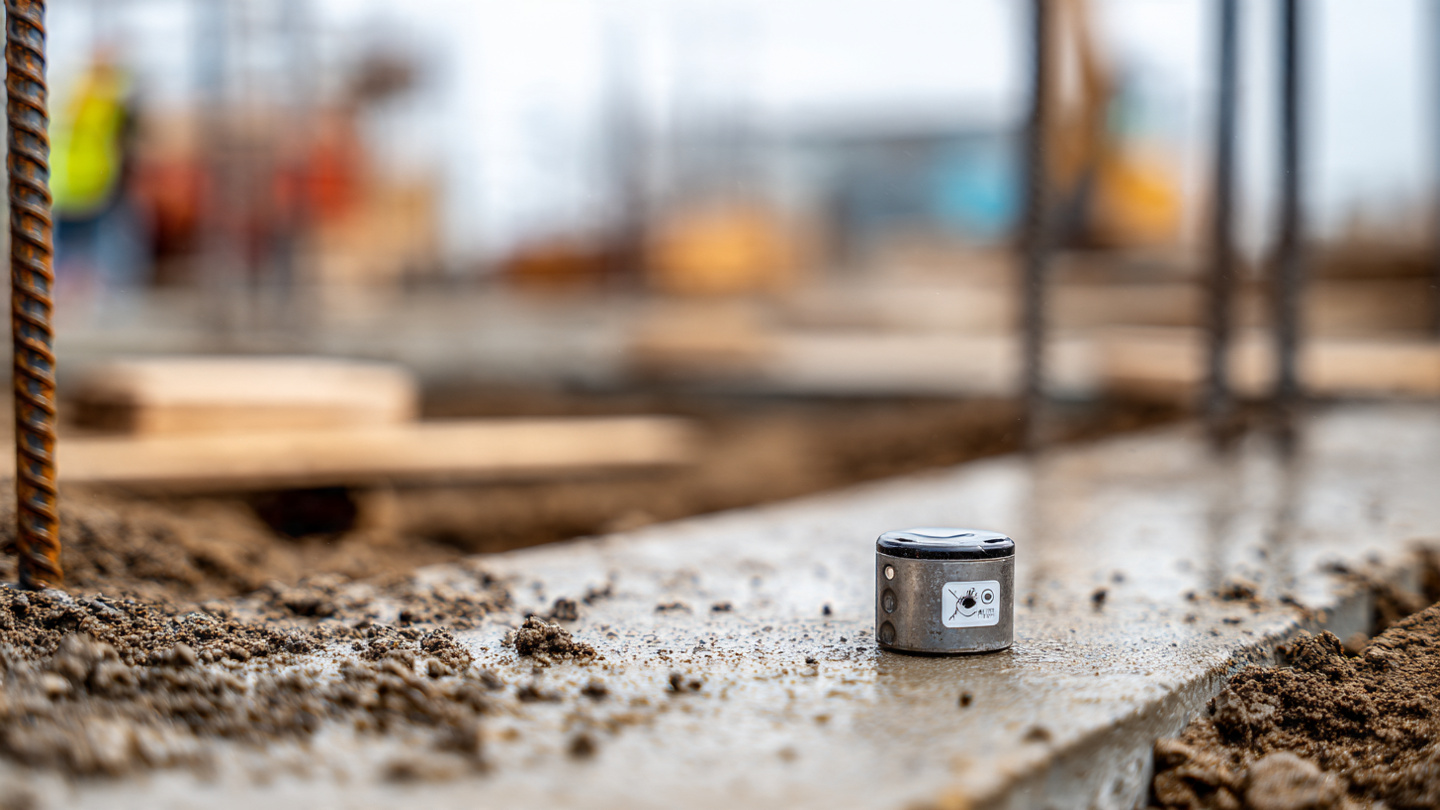
Three days of idle crew, form rental charges ticking over, and a construction loan bleeding $333 a day in carry costs, all because the residential industry treats concrete curing like a calendar event instead of a chemistry problem with a measurable answer. A wireless sensor the size of a hockey puck, zip-tied to your rebar before the pour, would have told you Saturday morning that the foundation was ready, and the total cost of knowing instead of guessing would have been $125.
What a Maturity Sensor Actually Does
Concrete does not gain strength on a schedule but through hydration, a chemical reaction between cement and water that accelerates with heat and decelerates with cold, which means two identical pours on the same site, one in July and one in November, will reach design strength days or even weeks apart depending on ambient temperature and mix composition. Cylinder break tests, the industry standard for decades, cannot tell you any of this in real time. You cast cylinders during the pour, ship them to a lab, and wait for 7-day and 28-day breaks, and by the time the lab report arrives you have either waited too long or guessed right by accident.
Maturity sensors change that equation entirely by measuring temperature inside the concrete every 15 minutes, then applying the Nurse-Saul or Arrhenius maturity function defined in ASTM C1074 to convert the temperature-time history into an estimated compressive strength, which means no lab, no waiting, and no guessing because you open an app on your phone and the number is right there on the screen, updated every quarter hour for the life of the sensor.
Giatec’s SmartRock3, the most widely deployed sensor in this category, retails for $125 per unit and transmits wirelessly up to 1,000 feet when embedded in concrete. You strap it to rebar, pour over it, and read strength estimates from the SmartRock app via Bluetooth or the SmartHub gateway, with a battery that lasts four months and a sensor body that stays in the concrete permanently after the forms come off because there is no retrieval step and no cleanup.
Where AI Enters the Picture
Classical maturity sensors are, at their core, thermometers with a formula attached. Useful, certainly, but limited by a critical dependency: you need a pre-calibrated strength-maturity curve for the specific concrete mix, which means casting lab specimens at multiple ages and testing them to destruction before you can trust the sensor’s output on the actual pour. For a production builder pouring the same 3,000 PSI mix on fifty foundations a year, that calibration cost amortizes to nothing. For a custom home builder doing three projects a year with three different mixes from three different batch plants, the calibration overhead is a chore that eats half the savings and explains why most small-volume builders have never bothered.
Two developments are now eliminating that barrier simultaneously, one from industry and one from the research lab. Giatec’s SmartRock Pro uses CEMMA (Cement Maturity Method Assessment), a proprietary algorithm that self-calibrates without a pre-established strength curve: you embed the sensor, pour the concrete, and the system figures out the strength trajectory from the hydration signature alone, no lab specimens required and no pre-pour calibration appointment to schedule.
Academic research is pushing even further beyond what commercial sensors currently deliver. A 2025 study published in Nature Scientific Reports combined real-time hydration monitoring with AI models and achieved 0.996 R² accuracy at 0.143 MPa RMSE for early-age strength prediction, while a separate Nature Communications paper demonstrated that piezoelectric sensors paired with deep learning can monitor strength continuously without any destructive testing at all, outperforming the traditional maturity method’s already-strong correlation on a validated highway project.
Commercial deployment is already underway on the infrastructure side, where Tarmac partnered with Converge in 2024 to deploy AI-enhanced concrete sensors that predict strength based on environmental conditions, Heidelberg Materials is distributing SmartRock sensors to ready-mix customers as a value-add service, and DeWalt published a contractor’s guide to the maturity method aimed squarely at the trades. When DeWalt writes a how-to for something, the tool has crossed from engineering curiosity to jobsite standard.
Running the Numbers for a Residential Foundation
Nobody has published a residential-specific ROI for maturity sensors. Every case study is highways, parking garages, or high-rise slabs. So here are the numbers for a standard single-family foundation pour.
Assumptions: Continuous footing and stem wall, 30 cubic yards of 3,000 PSI concrete (standard per IRC R402.2), moderate weather above 50°F. Traditional approach: strip wall forms at day 7 per JLC guidelines, wait for 7-day cylinder break confirmation, begin framing on day 8 or 9.
| Cost Item | Traditional | With Sensors |
|---|---|---|
| Concrete testing (lab cylinders) | $400–$600 | $0 |
| Sensors (4 × $125) | $0 | $500 |
| Form rental (wall forms, extra days) | $200–$400 extra | $0 extra |
| Framing crew idle (3–4 days × $400/day) | $1,200–$1,600 | $0 |
| Construction loan carry (3–4 days) | $1,000–$1,332 | $0 |
| Total excess cost | $2,800–$3,932 | $500 |
Net savings: $2,300 to $3,432 per project. That is a 360 to 586 percent return on a $500 sensor investment. For a production builder doing 20 foundations a year, the annual savings land between $46,000 and $68,640. Giatec claims $30,000 to $50,000 in annual savings for commercial projects; the residential math is actually better per dollar spent because the schedule compression matters more when your framing crew and loan clock are both running.
Why Nobody Does This on Houses
Three reasons explain the gap, and two of them are fixable without waiting for anyone’s permission.
Inspectors do not know what it is. Most residential building inspectors have never seen a maturity sensor and have no framework for accepting real-time strength data in lieu of cylinder break reports, even though the IRC does not explicitly require cylinder breaks for residential foundations and merely specifies minimum compressive strength (3,000 PSI per R402.2) without mandating a particular testing method. ASTM C1074 is a recognized, published standard that has been in continuous use since 1987, but an inspector who has spent 20 years asking for 7-day breaks is unlikely to accept a phone screen showing a maturity curve without some advance persuasion and, ideally, a pre-approved testing plan filed with the jurisdiction before the pour date.
Calibration overhead scares people off. Classical maturity requires casting and breaking specimens to establish the strength-maturity curve for each mix, and for residential projects where you pour once and move on to the next client, the setup feels like it costs more in effort than it saves in schedule. SmartRock Pro’s self-calibrating CEMMA technology eliminates this step entirely, but awareness outside the infrastructure world remains low.
Residential builders do not think in schedule-cost terms. A GC managing a $50 million commercial project tracks idle crew costs to the hour, but a residential builder managing a $500,000 custom home often treats the seven-day curing wait as fixed overhead, a line item in the mental budget that feels as immovable as the weather. Reframing that wait as $2,800 in unnecessary cost, money that could have stayed in the client’s pocket or the builder’s margin, changes the conversation entirely.
If You Are Pouring a Foundation Next Month
Buy four SmartRock3 sensors from any concrete testing supplier for a total of $500. Before the pour, zip-tie one sensor to rebar at each corner of the foundation, positioning each at least 2 inches from the form face and 2 inches below the top surface so it sits fully embedded in the mass of the pour rather than at an edge where temperature readings would skew low.
Activate each sensor by scanning its QR code with the free SmartRock app. Pour as normal. Within hours, the app will display real-time temperature and estimated maturity index, and when that index corresponds to your target strength (typically 75% of f’c, or 2,250 PSI for a 3,000 PSI spec) you have data to support stripping forms rather than a calendar date that may or may not reflect what actually happened inside the concrete.
Share the maturity data with your inspector before the pour, not after, and explain that you plan to use ASTM C1074 as the acceptance method. Some jurisdictions will approve it immediately because the standard is well-established and code-compliant. Others will require a parallel cylinder test the first time around, but even in that scenario you establish a precedent that eliminates guesswork on every subsequent pour with the same mix design, which means the second and third foundations that year benefit fully even if the first one required the belt-and-suspenders approach.
For custom builders doing fewer than five projects a year with varying mixes, SmartRock Pro (self-calibrating) is worth the premium. You skip calibration entirely and still get real-time strength estimates.
A Credible Argument Against All of This
Maturity sensors were engineered for high-volume infrastructure and commercial construction, environments where the same mix design gets poured hundreds of times and the calibration cost disappears into statistical insignificance. Residential is different: one pour, one mix, one inspection, and if your inspector refuses to accept maturity data, you still need cylinder breaks and you have now paid for both the sensors and the lab. If you are a homeowner hiring a builder, the sensor cost is trivial, but the schedule savings depend entirely on whether your builder is willing to learn the method and whether your jurisdiction will cooperate, and if either party insists on the traditional seven-day wait regardless of what the sensor says, you spent $500 on a very expensive temperature log.
This is a real barrier, not a straw man. Adoption in residential construction is blocked by culture rather than technology. But the counterargument weakens with every production builder who standardizes on maturity sensors, every inspector who learns to read the ASTM C1074 output, and every ready-mix supplier who hands out SmartRock units alongside the delivery ticket. Infrastructure and commercial already made the switch. Residential is the laggard, and the distance is shrinking.
What This Analysis Does Not Cover
All cost calculations assume moderate weather above 50°F. In cold weather, hydration slows dramatically and maturity sensors will correctly show that the concrete is not ready, which means the schedule savings shrink or vanish entirely. Winter pours in northern climates add variables (heated blankets, insulated forms, accelerating admixtures) that change the math. Sensor accuracy in extreme conditions has not been independently validated for residential-scale pours. Giatec’s claimed sensor specifications are manufacturer-reported. No third-party audit of SmartRock accuracy in residential applications has been published. Jurisdiction acceptance varies widely and no national survey of inspector willingness to accept ASTM C1074 data for residential foundations exists.