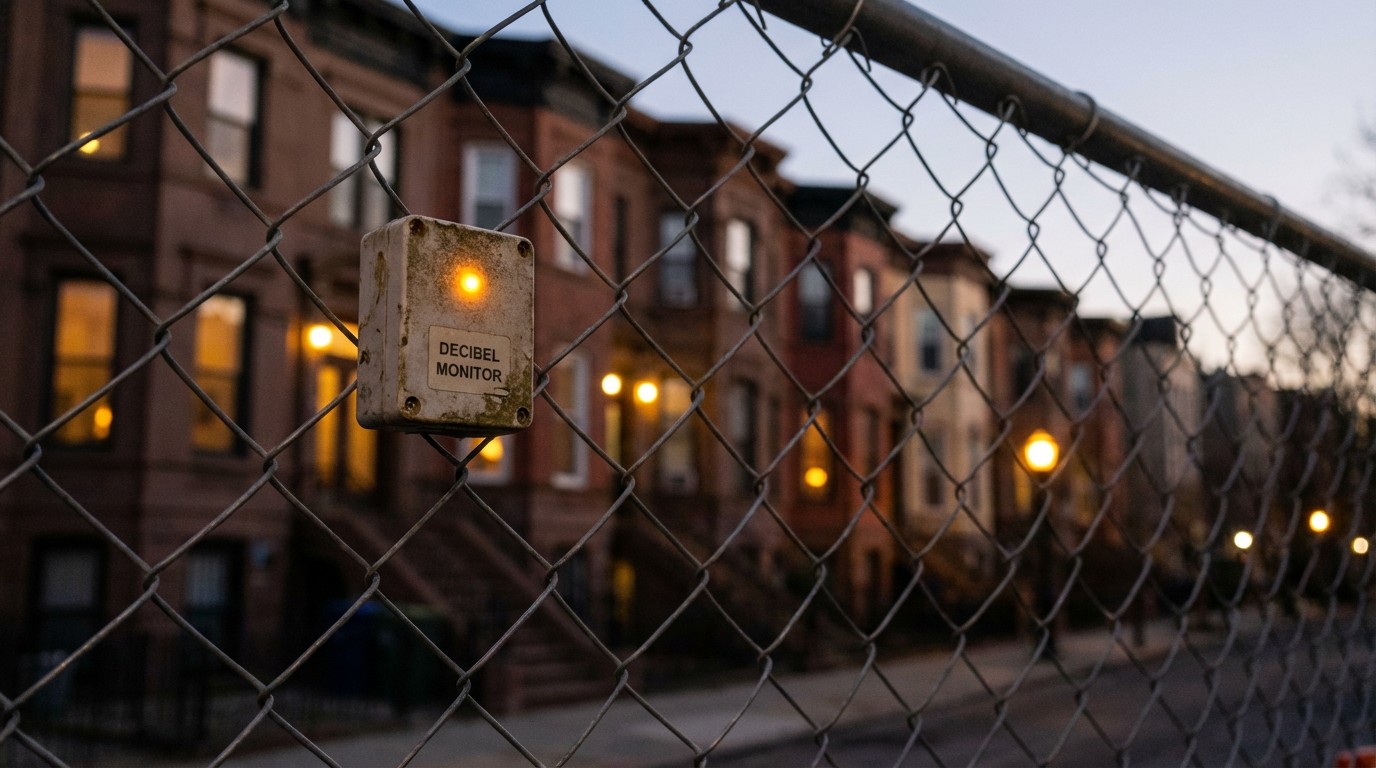
On April 21, 2026, New York City will require continuous noise monitoring devices on every major construction site within 50 feet of a residence. The sensors must face the nearest home. They must record throughout construction. The data goes to the city.
This is not a proposal. The rule was adopted by the NYC Department of Environmental Protection in March 2026.
The current mandate applies to new buildings of 200,000 square feet or more—large-scale commercial and residential towers, not your neighbor’s kitchen renovation. But anyone who reads regulations for a living can see the trajectory. New York logged more than 700,000 noise complaints through 311 in 2024. Over 20,000 came specifically from after-hours construction. Noise was the city’s number-one complaint category.
The 200,000 sq ft threshold is a political starting point, not a technical boundary.
What the Rule Actually Requires
The specifics matter more than the headlines suggest. Each qualifying site must install at least one IEC 61672-1 Class 2 noise monitoring device, mounted 8 to 10 feet off the ground on a wall or pole, aimed at the nearest residential receptor. Wall-mounted devices need at least one foot of clearance from any surface to prevent acoustic reflection from corrupting readings. Outdoor microphones must include wind and rain protection.
The application for an Alternative Noise Mitigation Plan—required for any construction operating outside standard permitted hours—now demands a map of all sensitive and residential receptors within 75 feet. That map must show proposed monitor locations, device count, and the name of the person responsible for the equipment.
Monitoring runs from the first day of exterior work until only interior renovation remains. Projects with existing ANMPs are grandfathered unless they renew after April 21, at which point they’re subject to the new requirements.
Affordable housing projects are exempt. Emergency infrastructure work is exempt. Everyone else is on the clock.
The Fine Math That Makes This Inevitable
NYC’s existing penalty structure for construction noise violations starts at $875 for a first offense. Repeat violations escalate to $2,625 each. Unauthorized after-hours work—the kind that generates the 20,000 complaints—carries fines starting at $1,400 per incident. Persistent noncompliance triggers stop-work orders under Section 24-223 of the NYC Administrative Code, which halt all activity until the violation is resolved.
A stop-work order on a large project can burn $50,000 to $150,000 per day in idle labor, equipment rentals, and delayed subcontractor schedules—numbers consistent with industry estimates from the Associated General Contractors and major GC insurers. Suddenly a $1,200/month noise monitor looks like the cheapest line item on the job.
And that’s the calculation regulators are banking on. Continuous monitoring doesn’t just catch violations—it prevents them, because the contractor knows the data exists.
AI Doesn’t Just Measure Decibels. It Identifies the Source.
Traditional sound level meters record a number. They tell you the site hit 94 dB at 11:47 PM. They don’t tell you whether that spike came from a concrete saw, a delivery truck backing up, or a steel beam dropped three stories.
That distinction matters enormously for compliance. A jackhammer exceeding limits during permitted daytime hours is a different violation (and a different mitigation strategy) than a generator running overnight. Source identification changes the conversation from “you were loud” to “this specific piece of equipment needs to be enclosed, relocated, or rescheduled.”
Svantek’s SvanNET AI platform uses machine learning to classify noise into 27 distinct source categories—industrial machinery, vehicle traffic, construction equipment, natural sounds—from audio captured at 16 kHz or higher. The system tags events automatically, without an acoustician sitting at a laptop. Sonitus Systems, with 7,000 active projects and 13,000 platform users worldwide, offers real-time alert triggers that notify site managers the moment decibel thresholds are crossed, paired with automated compliance reports generated without manual intervention.
Neither system is experimental. Both are deployed at scale on active construction projects right now.
What a Monitor Actually Costs
Equipment rental rates from Scantek, one of the largest acoustic instrument rental houses in the US, put the numbers in perspective:
| Equipment | Daily | Weekly | Monthly |
|---|---|---|---|
| Class II sound level meter (basic compliance) | $65 | $325 | $1,200 |
| Class I meter + octave analysis + audio recording | $80 | $400 | $1,400 |
| Class I meter + octave + audio + FFT analysis | $85 | $425 | $1,500 |
Twelve to fifteen hundred dollars a month for a Class I monitor with full analysis capability. On a project where a single stop-work day costs six figures, that’s rounding error. On a custom home build where the budget is tighter, it’s still less than a single noise violation fine.
Cloud-based platforms like Sonitus add a subscription layer for real-time dashboards, automated reporting, and alert management. Exact pricing is project-specific, but the total cost of a monitored site—hardware rental plus cloud—typically falls between $1,500 and $3,000 per month. For reference: that’s less than most projects spend on portable toilet servicing.
This Won’t Stay in New York
New York moves first on building regulation because it has the density, the complaint volume, and the political pressure to justify enforcement. But the pattern is well-established. Local Law 97 (building emissions caps) is already being replicated in cities across the US. Energy benchmarking ordinances spread from New York to 40+ cities in a decade. Noise monitoring will follow the same arc.
The Arup report on construction noise—drawing on WHO data—attributes 48,000 new cases of ischemic heart disease and 12,000 premature deaths annually in Europe to environmental noise exposure. Those numbers are in the public record. They will show up in legislative testimony in Los Angeles, Seattle, Austin, and every other city where residential construction sites share property lines with occupied homes.
The FHWA updated its Construction Noise Handbook as recently as March 2026, with expanded guidance on monitoring, prediction modeling, and mitigation. The federal infrastructure is being built. The city ordinances will follow.
What Residential Builders Should Actually Do
If you’re a custom home builder or remodeler operating near occupied properties, the time to care about this is before your municipality requires it. Two reasons.
First, voluntary monitoring kills complaints before they become violations. A noise sensor mounted on the property line is a tangible signal to neighbors that you’re managing the impact. The Sonitus platform even offers a public-facing portal where residents can see real-time levels—transparency that disarms adversarial relationships before they start.
Second, the data protects you. When a neighbor files a noise complaint and the city inspector arrives, a continuous monitoring log showing you were at 72 dB against a 75 dB daytime limit is an airtight defense. Without monitoring, you’re arguing perception against perception. With it, you’re showing timestamped, calibrated, court-admissible data.
A Class II meter, a cellular modem, and a cloud subscription. Budget $1,500/month for the duration of exterior work. It’s cheaper than the lawyer you’ll need when the third complaint triggers a code enforcement visit.
What This Doesn’t Solve
Monitoring doesn’t make construction quiet. A pile driver at 50 feet is 94 dB whether anyone is measuring it or not. The monitor doesn’t absorb sound. It doesn’t install acoustic barriers. It doesn’t resequence your critical path to move the loudest operations to midday when fewer neighbors are home.
AI source classification is still maturing. Svantek’s 27-category system works well in controlled deployments, but real job sites layer multiple noise sources simultaneously—a concrete pump, two radios, and a backing alarm don’t decompose cleanly into discrete categories. The AI will misclassify overlapping sources at least some of the time.
The NYC rule also has a conspicuous hole: it exempts 100% affordable housing projects. The political logic is clear. The acoustic logic is nonexistent. A jackhammer outside an affordable housing site produces the same 110 dB as one outside a luxury tower. The neighbors don’t hear a subsidy discount.
And the 200,000 sq ft threshold means most residential construction—single-family homes, duplexes, small multifamily—isn’t covered yet. The mandate will expand. But right now, the gap between what’s required and what’s useful is wide enough that voluntary adoption is the only way residential builders get the benefit.