Danny Reeves hung up his stilts last October. Twenty-three years of overhead taping, mudding, and sanding had left him with a torn rotator cuff, two bad knees, and a referral to an orthopedic surgeon in Tacoma. He was 47. His foreman told him most finishers don’t make it past 50.
Nobody tapes your joints with a farewell card. Drywall finishing is one of the hardest trades to staff, one of the most punishing on the body, and one of the least visible to anyone who hasn’t stood on stilts at 7 a.m. with joint compound dripping down their arm. It takes five to seven days of spraying, sanding, and recoating to finish a typical floor. It wrecks shoulders, backs, and knees. And for the first time in the trade’s history, a robot can do the hard part in two.
The Machine on the Jobsite
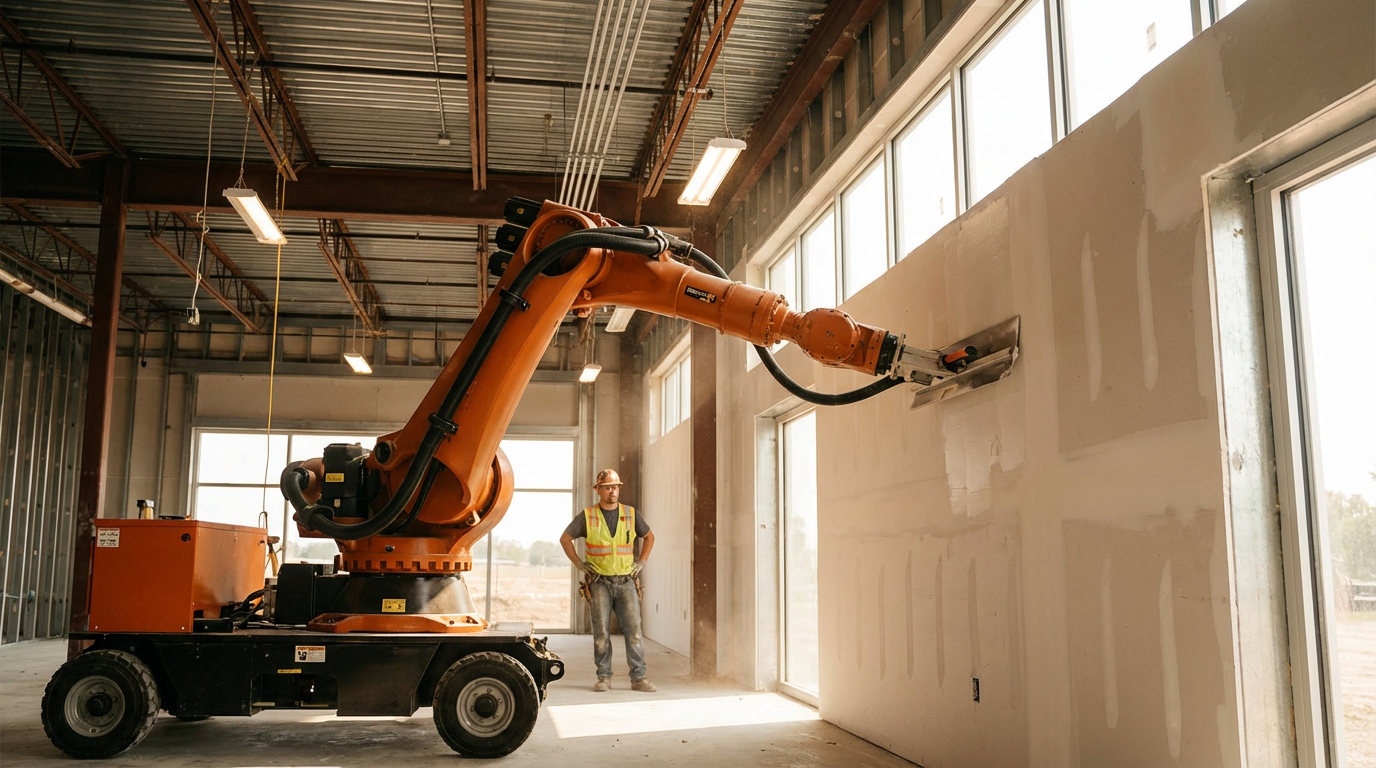
Canvas, a San Francisco startup backed by Menlo Ventures and Suffolk Construction, has raised $43 million to build what amounts to the first commercially deployed drywall finishing robot. Their 1200CX is a 1,200-pound autonomous platform built around a Universal Robots UR10e collaborative arm. It applies a defined layer of joint compound in one pass on day one, lets it dry, then sands to a Level 4 or Level 5 finish on day two.
No stilts. No overhead sanding. No five separate return trips to the same wall. One operator supervises the machine after roughly a week of training. All-wheel steering lets the 30-by-34.5-inch unit navigate tight corridors. It reaches 12 feet on a single charge that lasts eight hours. Canvas also makes the taller 1550 model for open spaces with higher ceilings; together the two units cover most commercial floor plates.
The project list already reads like a portfolio, not a pilot. Canvas robots have finished walls at San Francisco International Airport’s Harvey Milk Terminal, UCSF’s Wayne and Gladys Valley Center for Vision, and the Chase Center Towers next to the Golden State Warriors’ arena. At the 73,000-square-foot Newark, California, Civic Center, general contractor Webcor used Canvas to deliver a Level 5 finish with a 34% reduction in cycle time and 99.9% dust recapture. Derek Stevens, Webcor’s drywall operations manager, called the result “magnificent” and noted that nobody mixed mud or held a nozzle by hand. Partners now include Webcor, Swinerton, and Suffolk.
Canvas CEO Kevin Albert put the labor math plainly: “We need to build twice as much in the next 40 years, but two people are retiring for every one entering the industry.”
Not Just Canvas
Tel Aviv-based Okibo is taking a different approach. Their autonomous robots use AI and 3D scanning to map wall surfaces before finishing, adjusting for irregularities that would normally require a skilled finisher’s eye. Performance Contracting Inc. (PCI), one of the largest specialty contractors in the U.S., began deploying Okibo units in 2025. Their first high-profile joint project: the Netflix House entertainment venue in King of Prussia, Pennsylvania, where Okibo’s robots handled drywall sanding at five times human pace while eliminating the repetitive overhead motions that destroy finishers’ shoulders.
Okibo’s COO Nadav Shuruk makes the safety case: “Robots can’t fall off ladders or get neck, back, arm, and shoulder injuries from repetitive movements, and our robots nearly eliminate dust on a jobsite, leading to healthier indoor air quality and better respiratory health.”
The company claims its robots can finish at five times the pace of a human crew, with minimal supervision and no setup time. Small enough to reach corners and tight spaces, they handle measuring and alignment automatically, cutting rework from misalignment errors.
And then there’s painting. PaintJet’s Bravo robot tackles commercial building exteriors with predictive analytics imaging, reportedly using 25% less paint than a human crew. It’s built for warehouses and office towers, not living rooms, but the trajectory is clear: if a robot can spray-finish a 200,000-square-foot distribution center, scaling down to a 2,500-square-foot house is an engineering problem, not a physics one.
Why Finishing Hurts More Than Framing
Framing is heavy. Roofing is dangerous. But finishing is repetitive in a way that compounds over years. Overhead taping requires sustained arm elevation. Sanding generates silica dust that settles into lungs. Stilts add fall risk on top of joint stress. BLS injury data groups these trades together as “drywall and ceiling tile installers,” but the finishing phase is where the musculoskeletal damage concentrates.
According to CPWR’s 2025 Aging and Retirement Trends report, the average construction worker’s age rose to 42.1 in 2023, up from 41.6 in 2011. More than 4.1 million Americans will turn 65 between 2024 and 2027. Only 26.4% of wage-and-salary construction workers participate in any retirement plan, compared to 34.3% across all industries. People aren’t choosing to leave the trade. Their bodies are making the choice for them.
Labor unions, notably, have embraced Canvas’s system rather than opposing it. Canvas is a signatory to District Council 16 of the International Union of Painters and Allied Trades (IUPAT). When the robot handles the overhead spray and sand, the finisher handles detail work, corners, and quality checks. Robert Williams III, DC16’s business manager, told Construction Dive the technology “is creating meaningful union career opportunities, helping introduce previously untapped communities to the trades and making the work itself safer.” It’s the difference between running a finishing crew and surviving one.
What It Costs (And What It Doesn’t)
Canvas doesn’t publish per-square-foot pricing. They operate as a service, deploying robots to commercial projects where the economics work at scale. A traditional drywall finishing crew charges $0.80 to $2.50 per square foot for labor alone, depending on region and finish level. Level 5 smooth finish adds another $0.80 to $3.00 per square foot on top of that. For a 10,000-square-foot commercial floor, finishing labor can run $25,000 to $55,000.
Cut the schedule from seven days to two and you save not just labor dollars but general conditions, equipment rental, and carrying costs on a construction loan that charges interest by the day. On a multifamily project with twenty identical floors, the compounding schedule savings dwarf the per-floor labor delta.
On a single-family home? The math is thinner. A 2,500-square-foot house might run $2,000 to $6,250 in finishing labor. Mobilizing a 1,200-pound robot, calibrating it to a one-off floor plan with twelve different ceiling heights and seventeen corners, then demobilizing it the next day doesn’t pencil the same way it does on a data center with 40,000 square feet of flat wall.
The Residential Gap
This is the honest part. Every finishing robot on the market is built for commercial construction. Canvas deploys on airports, data centers, hospitals, and warehouses. Okibo’s first U.S. customers are large specialty contractors. PaintJet paints building exteriors, not bedrooms.
Custom homes have irregular geometries, mixed ceiling heights, curved walls, built-in niches, soffits, and trim details that require human judgment. A robot that excels at 200 linear feet of flat wall stumbles at the junction between a vaulted great room and a coffered dining ceiling. The AI vision systems are getting better at reading surface irregularities, but residential finishing is an adaptation problem more than a production problem.
Production homebuilders are the bridge. A tract development with 200 identical floor plans, standard 9-foot ceilings, and uniform wall layouts is basically a commercial project wearing a residential permit. If Canvas or Okibo can prove ROI on a Lennar or D.R. Horton subdivision, the technology migrates down to mid-volume custom builders within a few years.
“Just hire a good finisher” works until there aren’t any. The median age in the trade is climbing. The apprenticeship pipeline is thin. And the guys who are good enough to run a Level 5 smooth finish at production speed can name their price, because there are four GCs bidding for their schedule.
What to Watch For
Canvas is developing a taller version of the 1200CX that will reach over 20 feet, addressing high-ceiling commercial spaces but also opening the door to two-story foyers and stairwells in residential builds. They’re also expanding into painting, combining multiple finishing tasks into a single robotic workflow. The tighter they can integrate, the more the per-mobilization cost spreads across tasks.
Okibo’s model is interesting because it requires no setup time and minimal tech skill to operate. If the price point drops to something a regional drywall subcontractor can lease, you could see these units showing up on mid-range residential jobs within three to five years. Not as replacements for the finisher. As the finisher’s second pair of arms.
For anyone building a house in 2026, none of this helps you today. Your finisher is still a person on stilts with a hawk and a trowel. But if you’re planning for next decade’s labor market, the machines are already on the jobsite. They’re just working on the building next door.
Sources: Construction Dive — Drywall Finishing Robot Saves Time, Prevents Injuries · Tech Briefs/SAE — Drywall Finishing Robots Accelerate Construction Schedules (Aug 2025) · Clay — Canvas Funding: $43M Total (Series A + Series B, Menlo Ventures) · Under the Hard Hat — Okibo AI Drywall Robot Reshaping U.S. Jobsites · Okibo — PCI Partnership on Netflix House, King of Prussia (Jul 2025) · Research Nester — Construction Robots Market $1.46B to $6.06B by 2035 · CPWR — Aging and Retirement Trends in Construction Industry (2025) · Equipment World — Construction Average Age Rises to 42.1 (Mar 2025) · Estimators.us — Drywall Installation Cost Guide (2025) · Engineering360 — PaintJet Bravo Robot Painter