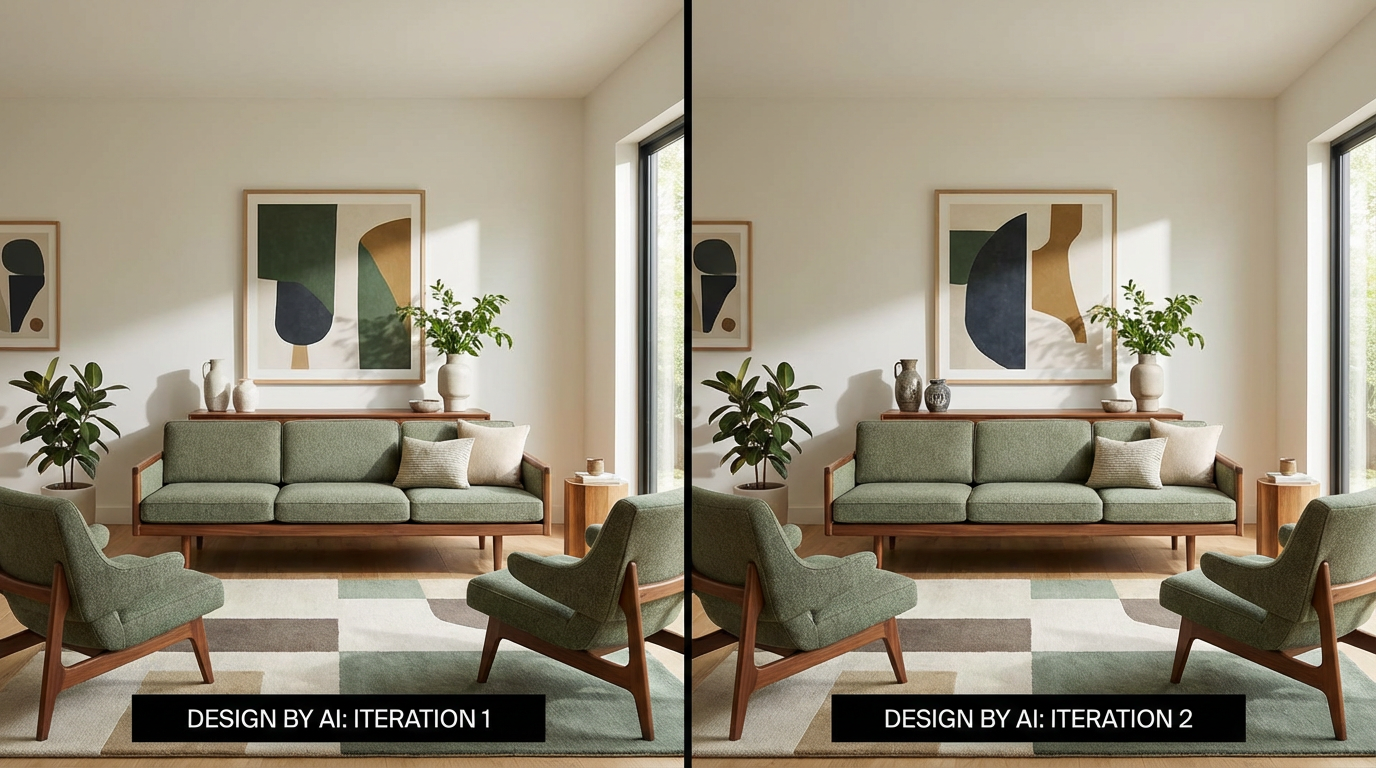
I ran the same experiment four times last week. Uploaded a photo of my sister’s 1940s bungalow living room — ten-foot ceilings, north-facing double-hung windows, original hardwood the color of dark honey — to four different AI interior design platforms. Selected “Mid-Century Modern” on each. The results arrived in seconds. Every single one placed a green velvet sofa against the south wall, flanked it with brass fixtures, and dropped a fiddle-leaf fig in a ceramic pot beside the window. Different apps. Same room.
Then I tried the bedroom. Same green velvet, this time as an accent chair. Same brass. Same plant.
Cheap, Fast, and Everywhere
The numbers explain why your neighbor is using one. RoomGPT: two million users. Planner 5D: 80 million registered accounts. Interior AI, ArchiVinci, Collov — more arriving monthly. Subscriptions run $10 to $39 per month. A human interior designer bills $200 to $300 per hour, and a full room redesign lands between $2,000 and $12,000 (Decorilla).
I don’t dismiss that math.
Seeing your actual room rendered in a style you’re considering — before you order the sofa, before the paint cans arrive, before the $4,000 mistake — is genuinely useful. Seventy-eight percent of homeowners exceed their renovation budgets (Clever Real Estate). A $29 preview that prevents even one wrong furniture purchase pays for a year of subscription on the first save. The tools deliver something real. What they deliver, though, has no depth.
What the Algorithm Sees
Every one of these platforms runs on the same fundamental operation: style transfer. Photograph in, labeled aesthetic applied, furniture catalog swapped, render out. The machine understands surface — material textures, color temperature, silhouette proportions — because surface is what photographs capture and what diffusion models learn from.
But a room is not a photograph.
A room is morning light crawling down an east-facing wall for three hours, then vanishing, leaving you with a paint color that looked warm in the render and reads cold all afternoon. It’s the path between the back door and the kitchen that your kids run fourteen times before dinner — a path the algorithm never saw because traffic patterns don’t appear in training data. It’s the cathedral ceiling that turns every conversation into a swim through reverb, the pocket door that won’t clear the console table the app recommended, the linen sofa that your cat will shred into a forensic exhibit within six weeks. A room has acoustics, thermal behavior, a relationship with the season. A style-transfer engine has pixels.
Two Million Users, One Living Room
This goes deeper than individual tool limitations. When two million users select “Scandinavian” or “Japandi” from the same dropdown trained on the same corpus of aspirational interiors, the output converges. It has to. The model learned what “Mid-Century Modern” looks like from tens of thousands of images that already agreed with each other — magazine shoots, Pinterest boards, furniture catalog renders. It doesn’t know that the interesting mid-century rooms were interesting precisely because someone broke the rules: a Saarinen table next to a Victorian settee, Marimekko fabric in a Neutra house, a wall of books where the design magazines said to put a credenza.
Taste, when it’s genuine, is idiosyncratic. It’s the weird piece that doesn’t belong until it does.
No diffusion model produces that. They produce the average of what they’ve seen, rendered beautifully. And the average, deployed to millions of living rooms simultaneously, creates a new kind of design crisis — not ugliness, but sameness at a scale the profession has never encountered. When every mid-century room has the same green sofa, it stops being mid-century anything. It becomes algorithmic wallpaper.
The Lobby, Not the Studio
The smarter operators figured this out early. Havenly, which absorbed AI-focused competitor Modsy’s assets in 2022, lets the algorithm handle the wandering — moodboards, style quizzes, quick renders of “what if the accent wall were terracotta” — then hands you to a human designer at $75 to $1,849 depending on scope. The designer does what the render can’t: crouches next to your radiator, measures the clearance behind your front door, asks why you hate overhead lighting. Decorilla runs a similar stack and claims the AI exploration phase cuts early costs by roughly 75%.
The pattern mirrors what we found with AI floor plan generators: the algorithm’s real gift is compression. A homeowner who walks into a designer’s office holding three AI-generated concepts instead of a vague Pinterest board has already answered the questions that burn the first two consultations. The designer still does the design. The conversation just starts in a more interesting place.
The Profession Splits
Walk through a mid-range furniture showroom in any major American city and you can see the fault line forming. On one side: the couples circling a room display with an iPad, comparing what the app rendered to what’s on the floor. On the other: the designer with fabric swatches fanned across her arm, explaining to a client why the velvet that photographs beautifully will pill in a house with dogs. Interior design is a $28.9 billion U.S. industry growing at 7.2% annually (Kentley Insights). It’s not dying. It’s dividing.
An Acorn Finance survey found 52% of homeowners have used AI to second-guess a designer’s recommendations. For designers whose work lives in the mood-board-and-sofa-selection tier, a $29 app now performs 80% of the job in four seconds.
But the other end — gut renovations, lighting schemes that account for circadian rhythms and February’s 23-degree sun angle, material selection that weighs how linen ages against how cotton velvet catches the particular gold of your west-facing windows at 4 p.m. — that work is intensifying. The designers doing it report that AI renders have become useful openers for client conversations. The spatial reasoning and vendor relationships that determine whether a renovation still functions twelve months later? Those require someone who has stood in the room.
The independent designer charging $150 an hour for a room refresh competes, now, with an app that handles most of the same scope in four seconds.
The gap — the 20% left over — is where a room becomes a home: the vintage Ercol chair that can’t be reverse-image-searched, the paint color that works because of your northern light, the layout shaped by how your family actually moves through space rather than how a stock photo arranges itself for a camera. That gap is narrow. It is also the only part that matters three years from now.
The Walls These Tools Can’t See Through
Ask any of these platforms about lighting design and you’ll get a brightness slider. Acoustics? Not modeled. Thermal comfort? Invisible. That $3,200 dining table the app renders so attractively? It won’t fit through your 32-inch doorway, and the software has no way of knowing that. It has never walked your hallway, felt the afternoon glare on your television screen, or watched a toddler sprint toward a floor-to-ceiling window with no guardrail.
The residential AI design segment is growing at 22% annually (Grand View Research), faster than any comparable market slice. Planner 5D already ingests smartphone photos to build 3D spatial models. The ambition is clear: tools that integrate smart home sensors, learn actual light conditions and traffic patterns, and generate suggestions grounded in how a space actually behaves rather than how it photographs. A Room Report — real-time environmental data layered over spatial understanding — that knows your light, your noise, your habits before recommending a single piece of furniture.
That tool doesn’t exist yet. What exists is powerful for wandering and dangerous for committing. Treat it the way a conservatory student treats a recording of a master performance: absorb the phrasing, study the structure, notice what makes the interpretation breathe.
Then close the app. Walk the room. Feel where the light falls.
Sources: AI Interior Design Market ($3.3B, 20.9% CAGR) — Grand View Research · RoomGPT: 2M+ Users — AIPure · Interior Design Industry $28.9B (2025) — Kentley Insights · AI Interior Design Pros and Cons — Decorilla · Havenly Review & Pricing — Decorilla · Renovation Spending Trends — Clever Real Estate · Home Improvement Statistics — Acorn Finance