A land acquisition manager at a mid-size regional builder in Raleigh-Durham opens her morning with five browser tabs. County GIS portal. Tax assessor records. A PDF of the municipal zoning code she downloaded six months ago and hasn’t checked for amendments since. Google Earth. And a spreadsheet she built herself, columns color-coded by lot status: green for available, yellow for maybe, red for “the owner hung up on me.”
She’ll evaluate five parcels this week. Maybe six if she skips the site visit on the lot in Holly Springs that looked promising on satellite but turned out to be a floodplain. By Friday, she’ll have narrowed that to two worth presenting to the VP of land. One will die in zoning review. The other might close in eight months.
Meanwhile, according to a November 2025 announcement from Prophetic, D.R. Horton’s AI platform screened 183,000 parcels across 20 states. It identified 3,000 candidates that passed zoning, environmental, infrastructure, and financial feasibility checks. That took less time than the Raleigh manager spent reading the Holly Springs zoning code.
A Shortage That Won’t Fix Itself
According to the NAHB/Wells Fargo HMI Survey from September 2025, 64% of single-family builders reported a shortage of buildable lots. That number has hovered between 62% and 67% for seven consecutive years. It never topped 53% before 2016, even when housing starts exceeded two million annually in 2005.
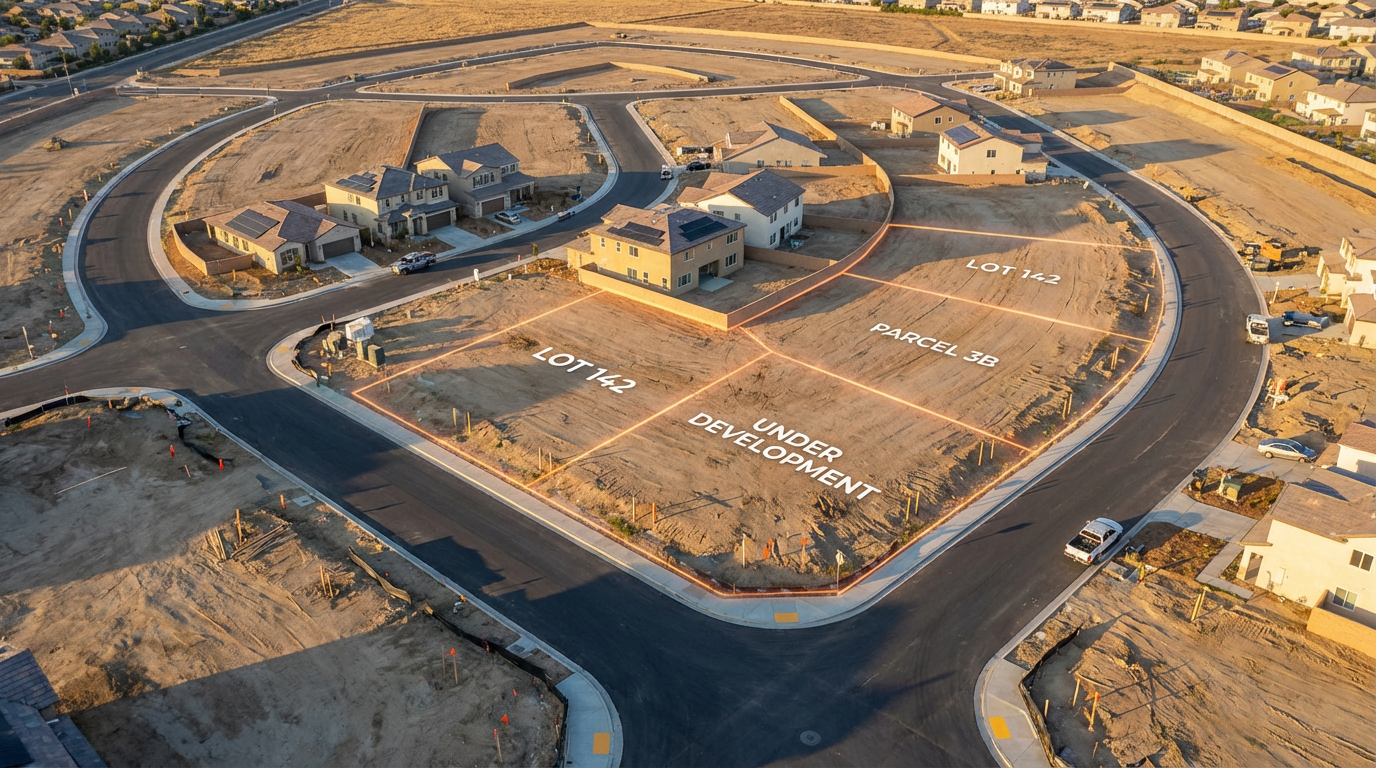
It isn’t raw land. America has plenty of dirt. It’s the 14-step obstacle course between “that looks like a nice field” and “we have permits to build 47 homes there.” Zoning classification. Environmental review. Wetland delineation. Utility capacity. Stormwater management. Traffic impact studies. Soil reports. Title search. Boundary survey. Topographic survey. Phase I environmental. Community opposition. Planning commission approval. And the financing to carry all of it for 18 to 36 months before breaking ground.
Each of those steps costs money. A professional land feasibility study runs $5,000 to $25,000 depending on complexity and market. Most builders do three to five of those before one converts to a closed deal. That’s $15,000 to $125,000 in due diligence on a pipeline that rejects 60 to 80% of candidates.
What $91,000 Buys You
NAHB’s 2024 Cost of Construction Survey puts the average finished lot at $91,100, or 13.7% of the $665,298 average sale price. That 13.7% is actually a series low as a share of total cost. In 2022, lots ate 17.8%.
But the dollar figure masks the real expense: time. A land team at a regional builder spends two to six weeks per parcel on due diligence. Zoning analysis alone requires decoding municipal code documents that average 400 to 600 pages and change quarterly. Most land analysts never read the full code. They call the planning department and ask. The planning department calls back in three days. Maybe.
At D.R. Horton’s scale (89,690 homes closed in FY2024, $36.8 billion in revenue), even a 5% improvement in lot acquisition efficiency represents $1.84 billion in throughput. That’s what makes an enterprise AI deployment pencil out at $50,000 to $200,000 a year in licensing fees.
Who’s Building What
No single tool covers the full pipeline. What’s out there splits into three lanes. I’ve spent two decades watching builders chase the same problems with slightly different hammers, so let me tell you which hammer does what and where I’d still keep my hand on the checkbook.
Prophetic went straight for the production builders. Their suite (ZoneAI, SiteAI, DevMap, DealDesk, SearchAI) screens thousands of parcels against zoning rules, environmental constraints, and pro forma targets simultaneously. D.R. Horton selected them for deployment across 30+ states in November 2025. I’d want to see it handle a Wake County PUD overlay before I believed the speed claims. And “screened 183,000 parcels” is Prophetic’s own language from a press release—we don’t know how many of those 3,000 flagged candidates survived a second look, let alone closed. But at enterprise scale, even a modest improvement in screening accuracy pays for the license ten times over.
Acres.com went after data breadth. Their database covers what the company says is 150 million-plus parcels with AI-powered natural language search: “200+ acre parcels with less than 10% flood plain, sewer access, residential zoning.” The parent company, AcreTrader, raised a $60 million Series B. For builders under 500 starts a year who don’t have a full-time zoning analyst on staff, which is most of them, the $200 to $500 monthly is the accessible entry point. Whether the data stays current at the parcel level across 3,000+ counties is the question nobody answers in the demo. I’d ask for a live pull on three parcels I already know the answer to before signing anything.
TestFit focused on the feasibility gap between “this lot looks promising” and “here’s what we can actually build on it.” Their configurator generates real-time site plans with automated parking, infrastructure takeoffs, and connected pro forma. TestFit raised a $20 million Series A and the company claims 6,200+ users generating site plans “up to 30x faster than manual methods”—their words, not independently verified. But I’ve watched a junior engineer spend three days on a site plan that a decent tool could rough out in 20 minutes. Even if the real number is 10x, it kills bad deals in hours instead of weeks. That’s the part I care about.
What the Algorithm Doesn’t See
A parcel on the edge of Apex, North Carolina, shows up as R-4 zoning, no flood plain, sewer stub within 200 feet, gentle 3% slope, 4.2 acres. The algorithm scores it high. A builder’s land team drives out there and finds a neighborhood association that filed 23 public comments against the last three rezoning applications within a mile. The planning commissioner who represents that district is up for re-election. The owner wants $180,000 per acre because a neighbor sold at that price in 2023, before rates hit 7%.
None of that is in the parcel data.
Community opposition, political dynamics, owner psychology, relationship capital with planning staff, the informal knowledge that a certain civil engineer gets plans through approval 30% faster in a given county. These are the inputs that close deals. An algorithm can’t return a phone call from a county commissioner at a Rotary lunch. Every deal I’ve closed in 20 years ended with a handshake, not a heat map.
And here’s the part the platform demos skip over: the costliest failures don’t happen at the screening stage. They happen at entitlement. Zoning approvals, community hearings, environmental review, the 14-month grind where a commissioner changes her mind because her constituents showed up. AI screens the front end. It doesn’t touch the back end, which is where most of the money burns. I’ve watched a builder carry $2.3 million in entitlement costs on a subdivision that died at the third public hearing. No algorithm would have predicted that the objection came from a retired soil scientist who actually read the stormwater plan.
A Novel Calculation: The Due Diligence Multiplier
We found no published industry estimate that accounts for rejection-rate-adjusted acquisition costs, so we calculated it ourselves.
A typical mid-size builder (500 to 2,000 starts per year) maintains a land pipeline of 15 to 25 active parcels under evaluation. Each parcel consumes 80 to 160 hours of staff time across land analysts, civil engineering consultants, and legal review. At a blended loaded rate of $85/hour for land staff (BLS reports a median $42/hour for urban planners; with benefits loading at 1.5–1.7x, senior land acquisition staff runs $65–$85/hour), that’s $6,800 to $13,600 per parcel in internal labor before a single dollar of external feasibility work.
Add the $5,000 to $25,000 in professional studies. With a 65% rejection rate (our midpoint estimate from industry interviews and NAHB data), the effective cost per acquired lot is:
($6,800 to $13,600 labor + $5,000 to $25,000 studies) × (1 / 0.35 success rate) = $33,700 to $110,300 per successful acquisition in due diligence costs alone.
That range is wide on purpose. A builder in Houston (minimal zoning, flat terrain) might sit at the low end. One in coastal California (CEQA, Coastal Commission, slope stability) blows past the top. And the 65% rejection rate is the most sensitive variable: at 40% rejection, the range drops to $19,700–$64,300. At 80%, it climbs to $59,000–$193,000. Small shifts in rejection rate move the final number by tens of thousands of dollars per lot.
That $33,700 to $110,300 sits on top of the $91,100 lot price. On a $665,298 home, due diligence represents 5.1% to 16.6% of the sale price. Nobody tracks this as a line item. It disappears into overhead.
If AI screening cuts the rejection rate from 65% to 40% by filtering out the obvious losers before human hours get burned, the same math produces $19,700 to $64,300 per acquisition. That’s a 40 to 42% reduction in due diligence cost per lot. On 500 lots per year, the savings run $7 million to $23 million. Enterprise SaaS pricing of $200,000 per year pays for itself before Q2. But note: those savings stack three estimated inputs (per-parcel cost, current rejection rate, post-AI rejection rate), none of which have been published by any builder or platform provider. Compounding uncertainty across all three means the real number could easily be half that range—or the entire premise could break if AI screening introduces false confidence that increases, rather than decreases, the rate of expensive late-stage failures.
Limitations
Our due diligence multiplier uses midpoint estimates and round numbers. The 65% rejection rate is an inference, not a measured statistic. NAHB reports that 64% of builders face lot shortages and that lot costs represent 13.7% of sale price, but neither source tracks deal rejection rates directly. The 65% figure is our estimate based on the ratio of feasibility studies initiated to lots closed across industry case studies and builder surveys. A reasonable midpoint, not a census. Different markets will produce wildly different numbers: a builder in Houston (minimal zoning, flat terrain, rapid permitting) faces a fraction of the due diligence burden of one in coastal California (CEQA, Coastal Commission, slope stability, species habitat).
The 40% post-AI rejection rate is our assumption, not measured. No builder we’re aware of has published before-and-after rejection rates from deploying AI screening tools. Prophetic’s 183,000-parcel claim tells us how many parcels were screened, not how many passed, and not how many of those passes led to closed deals.
We also couldn’t verify pricing for any of the platforms discussed. Enterprise SaaS deals in this space are negotiated individually. The $50,000 to $200,000 range is our estimate based on comparable proptech platforms, not published pricing.
Where This Leaves the Raleigh Land Manager
Fewer wasted hours on bad deals also means fewer hours billed. If AI screening cuts rejection rates in half, builders need fewer land analysts evaluating parcels that were never going to close. The Raleigh manager who starts her week with 50 pre-screened candidates instead of five is also the Raleigh manager whose employer wonders why the land team needs four analysts instead of two. The tool that makes her Monday better might make her position harder to justify by December.
She’s still going to drive to Holly Springs. She’s still going to call the planning department. She’s still going to sit through a three-hour community meeting where a retired engineer objects to stormwater calculations he hasn’t read.
But she might start her week with 50 pre-screened candidates instead of five she found by driving around. Her floodplain lot never makes it to her screen. The one with 23 public comments against adjacent projects gets flagged, even if the zoning looks clean. She spends her relationship capital on lots that have already cleared the data hurdles.
In 20 years of project management, the single biggest waste I’ve seen isn’t bad construction. It’s good people spending months on deals that were never going to close. If an algorithm can kill those deals on Monday morning instead of Friday afternoon, the builders who adopt it will find lots. The ones who don’t will keep driving around Holly Springs, wondering where all the good land went.
Sources
- November 2025 announcement from Prophetic. prnewswire.com
- NAHB/Wells Fargo HMI Survey from September 2025. nahb.org
- Prophetic. prophetic.ai
- Acres.com. acres.com
- raised a $60 million Series B. acretrader.com
- TestFit. testfit.io
- $20 million Series A. dallasinnovates.com