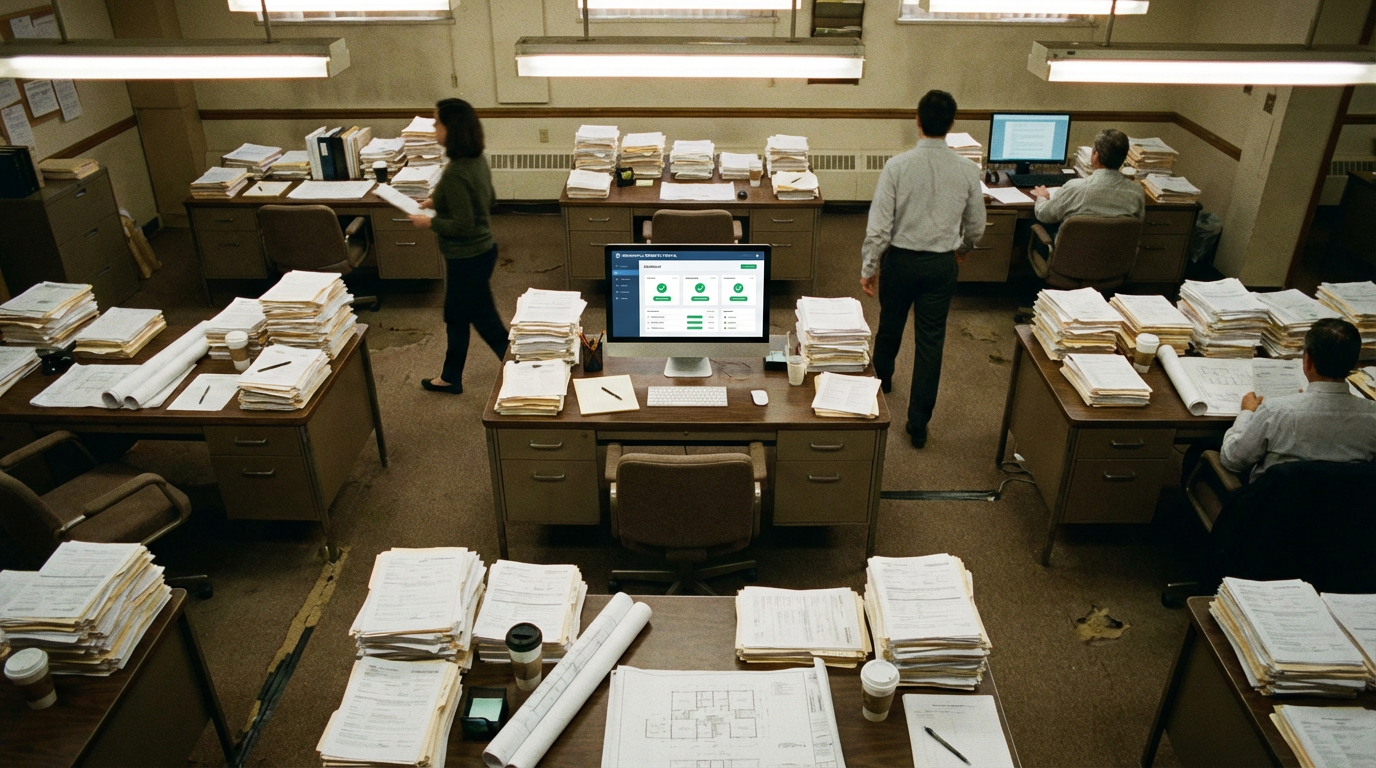
In the lobby of the Honolulu Department of Planning and Permitting, there used to be a number dispenser. Not the deli-counter kind. This one handed out tickets to builders who had already submitted their plans, paid their fees, and done everything the city asked. They were waiting to find out if a human being had looked at their paperwork. The median wait for a commercial permit was 393 days.
Let that number settle. 393 days to learn whether your application contained an error on page 14 of a 200-page submission. Not 393 days to get approved. 393 days to get read.
According to the NAHB’s 2024 regulatory cost analysis, regulation now accounts for $93,870 of the average new home’s price tag. That’s 23.8% of the sale price going to fees, code compliance, and the bureaucratic friction of getting permission to build a house. Building permit fees alone run $7,640. Water and sewer inspections add $6,260. Architecture and engineering, $6,480. Impact fees, $6,367. And 95.9% of the developers surveyed reported delays averaging six months. Not from construction. From waiting.
The 80% Problem
According to data compiled by Rescope from multiple city permitting departments (note: Rescope is itself a vendor in the permit-technology space, so treat these as industry-compiled figures, not independent research), 80% of residential permit applications contain significant zoning deficiencies. Not minor formatting issues. Real problems: setback violations, lot coverage miscalculations, missing easement acknowledgments, height limit conflicts. The average application requires 1.6 resubmissions before it clears review.
Every resubmission goes back to the bottom of the pile. A six-month queue becomes nine months. Some jurisdictions have told me it becomes twelve. And the reviewer who catches the error on page 14? She’s also reviewing the other 500 applications in her stack, many of which have the same setback miscalculation because the zoning overlay district updated its tables in January and nobody sent a memo.
I’ve managed projects in jurisdictions where the plan reviewer personally knew the zoning code better than the architects submitting plans. That’s not a compliment to the reviewer. It’s an indictment of a process that assumes every applicant will read a 600-page municipal code, check for quarterly amendments, and apply setback tables that reference three different overlay districts depending on which side of a creek the lot sits on.
Permitting delays push project costs up 11 to 15%, according to Rescope’s multi-city data. On a $400,000 home, that’s $44,000 to $60,000 in additional cost before a single nail gets driven.
What Six Months Actually Costs
Nobody publishes the carrying-cost math. So we did it.
A builder carrying a $400,000 project through permitting pays interest on the construction loan (or land loan, or bridge financing) regardless of whether anyone has looked at the plans. At current construction loan rates of 8–10% (per Bankrate’s 2025 construction loan survey), monthly interest alone on a $400,000 loan runs roughly $2,700 to $3,300. Add property taxes, insurance, and consultant retainers, and monthly carrying cost runs $2,000 to $3,000 for a mid-range project with typical leverage.
Six months of carrying cost: $12,000 to $18,000 per home. Not in construction costs. Not in materials. In waiting.
Now multiply. The Census Bureau recorded 1.5 million single-family building permits in 2024. If AI pre-screening could cut average permitting timelines from six months to one or two months (a range consistent with the results cities are reporting), that saves $8,000 to $15,000 per home in carrying costs alone.
At national scale: $12 billion to $22.5 billion per year in carrying costs that exist because applications sit in a queue waiting to be read.
We haven’t seen anyone else publish this cross-multiplication. The NAHB tracks regulatory costs. The Census Bureau tracks permits. Individual cities track their queue times. But nobody has lined up all three numbers and asked what the waiting itself costs at national scale. Twelve to twenty-two billion dollars is our estimate. It could be higher if you include multi-family, commercial, and renovation permits. It could be lower if you assume a portion of that delay is legitimate review time rather than queue time. But even at the conservative end, it’s a staggering amount of money that isn’t buying safety or quality. It’s buying a place in line.
Honolulu: From 393 Days to 3
Honolulu adopted AI pre-screening tools from Clariti and CivCheck to attack the 393-day median wait. The system reads submitted plans against the city’s zoning and building codes, flags deficiencies, and returns a compliance report before a human reviewer ever opens the file. Applications that pass pre-screening jump the queue. Ones that don’t get sent back with a specific list of what needs to change, not a form letter that says “deficiencies noted, please revise and resubmit.”
The result, according to data reported by Rescope and confirmed by Construction Dive: time-to-reviewer dropped from six months to two to three days. That’s a 60x improvement. Not in total approval time. In the time it takes for a human to first look at your plans.
Two to three days. I’ve waited longer for a county inspector to return a phone call.
Who’s Doing What
Austin adopted Archistar after a three-month pilot in October 2024, starting with single-family residential. Development Services Director José Roig said the software “was able to accurately understand our zoning code” and that “results of the analysis were reliable and repeatable across a wide range of residential projects.” Five-year contract. Collaborating with the International Code Council on building code compliance automation. The ambition is bigger than one city.
Hamilton, Ontario, partnered with the Bloomberg Center for Public Innovation and reported a 60% reduction in permit processing times. I’d want to see that number broken down by permit type before celebrating. Los Angeles County launched an AI “e-check” tool in April 2025 specifically to accelerate wildfire recovery permits, where the political pressure to move fast was overwhelming. Seattle is piloting AI pre-screening under Mayor Harrell’s executive order, with full rollout projected for late 2026.
PermitFlow raised a $54 million Series B led by Accel in December 2025, valuing the company at roughly $500 million. Their platform automates document preparation, jurisdictional intelligence, and workflow management for general contractors, developers, and homebuilders. Half a billion dollars in venture capital says the market agrees permitting is broken. Whether PermitFlow specifically has cracked the code is a different question. Venture capital has been wrong about construction tech before. Remember Katerra?
“But Permits Protect People”
Every time someone proposes speeding up permitting, a reasonable person says: permits exist to protect homeowners from shoddy construction. Cutting the timeline means cutting corners on safety.
It’s a fair concern, and it deserves a direct answer.
AI pre-screening doesn’t replace human review. It replaces the queue. Right now, a plan reviewer in a busy jurisdiction spends the majority of her day on applications that contain errors she’ll kick back. She checks setbacks against the zoning table. She verifies lot coverage. She confirms the structural engineer’s load path matches the architectural plans. Eighty percent of the time, she finds something wrong, writes a correction notice, and sends it back. The applicant fixes it (or doesn’t), resubmits, and the cycle starts over.
AI pre-screening catches those errors before the application reaches the reviewer. The architect gets a compliance report in minutes instead of months. She fixes the setback violation before submitting. When the reviewer finally opens the file, it’s clean. She can focus on the complex judgment calls that actually require human expertise: unusual structural configurations, site-specific drainage concerns, the things that protect people.
But there’s a risk nobody in the vendor pitch decks mentions: what happens when the AI misses a deficiency? When it tells an architect the setback is compliant and it isn’t? The reviewer, trusting the pre-screening, might skim instead of scrutinize. We haven’t seen any published data on AI pre-screening false-negative rates. Until someone runs an independent audit comparing AI-flagged deficiencies against human-caught deficiencies on the same application set, the accuracy question remains open. Cities adopting these tools are, in effect, running the pilot and the production deployment simultaneously.
As Austin’s Roig put it, the technology lets reviewers “focus on the unique aspects of an application, taking advantage of their expertise.” The review still happens. The safety check is still there. What disappears is the three-month loop of catching typos. What remains unproven is whether the AI catches everything the three-month loop used to catch.
The 39,000-Jurisdiction Problem
The United States has over 39,000 jurisdictions with independent permitting authority. Most of them are not Honolulu. Most are not Austin. Most are county offices with three plan reviewers, a filing system that runs on paper, and a zoning code last updated in 2004.
NAHB data confirms this fragmentation. Each jurisdiction sets its own fees, its own code amendments, its own process. A builder working across three counties in the same metro area may deal with three different fee structures, three different submittal requirements, and three different interpretations of the same International Building Code provision. One county accepts digital plans. The next requires five sets of 24-by-36-inch paper prints.
For AI to work, it needs to ingest the local code. Not the IBC or IRC template. The actual adopted code, with the local amendments, the overlay districts, the special flood hazard area requirements that apply to three blocks on the south side of town. Building that code library for 39,000 jurisdictions is a data problem that makes most enterprise software challenges look trivial.
PermitFlow’s $500 million valuation is partly a bet that they can build that jurisdictional intelligence layer. Archistar’s ICC partnership is a bet that they can work from the code source down. Both approaches have merit. Neither has solved the last-mile problem: the small county that adopted six local amendments to the energy code in 2019 and posted them as a scanned PDF on a website that hasn’t been updated since.
A Novel Calculation: National Carrying-Cost Burden
We built the $12 to $22.5 billion estimate from three published inputs:
Input 1: NAHB reports 95.9% of developers face approximately 6-month permit delays. We used 6 months as the baseline delay.
Input 2: Monthly carrying cost on a $400,000 home at current construction loan rates of 8–10% (Bankrate 2025), plus insurance, property tax, and consultant retainers, runs $2,000 to $3,000.
Input 3: The Census Bureau recorded 1.5 million single-family building permits in 2024.
The calculation: If AI pre-screening reduces average queue time from 6 months to 1–2 months (consistent with Honolulu’s 60x improvement and Hamilton’s 60% reduction), that saves 4–5 months of carrying cost per home. At $2,000–$3,000/month, that’s $8,000–$15,000 per home. Multiply by 1.5 million permits: $12 billion to $22.5 billion.
Each input carries uncertainty. Not all 1.5 million permits face six-month delays. Not every builder’s carrying cost runs $3,000/month. And AI won’t collapse timelines uniformly across 39,000 jurisdictions. The real number could be half our estimate. But even at $6 billion, it represents a transfer of wealth from builders (and ultimately homebuyers) to the void of administrative delay. That money doesn’t go to safer buildings. It goes to interest payments on loans that exist because nobody read the plans.
Limitations
Our carrying-cost estimate stacks three approximations. The 6-month delay is an NAHB survey average, not a measured median across all jurisdictions. Monthly carrying costs of $2,000–$3,000 assume a typical construction loan structure; builders with cash reserves or different financing models face different numbers. And 1.5 million annual permits is a round figure from Census data that fluctuates year to year.
The Honolulu and Hamilton timelines reflect time-to-reviewer, not total approval time. A project that reaches a reviewer in three days instead of six months may still take weeks or months in the review process itself. We have not seen published data on total cycle time reductions.
The 80% deficiency rate and 1.6 resubmissions figure comes from Rescope, which is itself a permit-technology vendor. While the data was compiled from municipal sources, it was curated by a company with a commercial interest in demonstrating that permitting is broken. We could not independently verify the 80% figure against raw municipal data.
AI pre-screening accuracy claims come from the technology providers and the cities that adopted them. Independent third-party audits of AI permit review accuracy are, to our knowledge, not yet published. Austin’s Director Roig described results as “reliable and repeatable,” which is a positive signal from a city official but not a peer-reviewed validation.
The 39,000-jurisdiction fragmentation means results from large, well-resourced cities may not generalize to smaller municipalities with limited digital infrastructure. Adoption curves in government technology historically run 10 to 20 years from early adopter to majority, and there is no reason to assume AI permitting will be different.
This article was produced with AI research assistance. All sources, calculations, and claims were verified by the editorial team against the primary documents cited.
Sources
- NAHB Regulatory Cost Analysis (2024) — $93,870 per home, 23.8% of sale price, 95.9% of developers report ~6 month delays
- Rescope — AI Transforming Building Permits (2026) — 80% deficiency rate, 1.6 avg resubmissions, Honolulu 6 months to 2–3 days, Hamilton 60% reduction
- Construction Owners Association (2025–2026) — Honolulu 393-day median, Clariti/CivCheck adoption, Austin/LA implementations
- Cities Today — Austin AI Permit Launch (2024) — Archistar pilot results, Director Roig quotes, ICC partnership
- PermitFlow Series B ($54M, Dec 2025) — Accel-led round, ~$500M valuation, end-to-end permitting platform
- NAHB 2024 Cost of Construction Survey — permit fees $7,640, water/sewer $6,260, architecture/engineering $6,480, impact fees $6,367