Turn on the shower. Wait. Feel the cold. Wait some more. Stick your hand under. Still cold. The average American home has 125 feet of ¾” pipe between the water heater and the farthest fixture. That pipe holds 3.14 gallons of stone-cold water, and every time you turn the faucet, all of it goes down the drain before anything warm arrives.
Do that ten times a day — showers, kitchen sink, dishwasher, hand washes — and you’re dumping 31 gallons. Over a year, that’s 11,461 gallons per household. Across the 25.2 million American homes with this problem, that’s roughly 300 billion gallons annually — flushed while people stand around in bathrobes waiting for steam.
The cause isn’t your water heater. It’s your pipes.
The Trunk-and-Branch Problem
Most homes are plumbed with trunk-and-branch systems — a fat main line that splits into progressively smaller branches feeding each fixture. It’s how plumbers have worked for a century, and it’s terrible for hot water delivery. Large-diameter trunk lines shed heat fast. Long horizontal runs through uninsulated joist bays lose even more. By the time water reaches the master bath on the second floor, it’s had plenty of time to cool to room temperature in sixty feet of copper sitting in your crawl space.
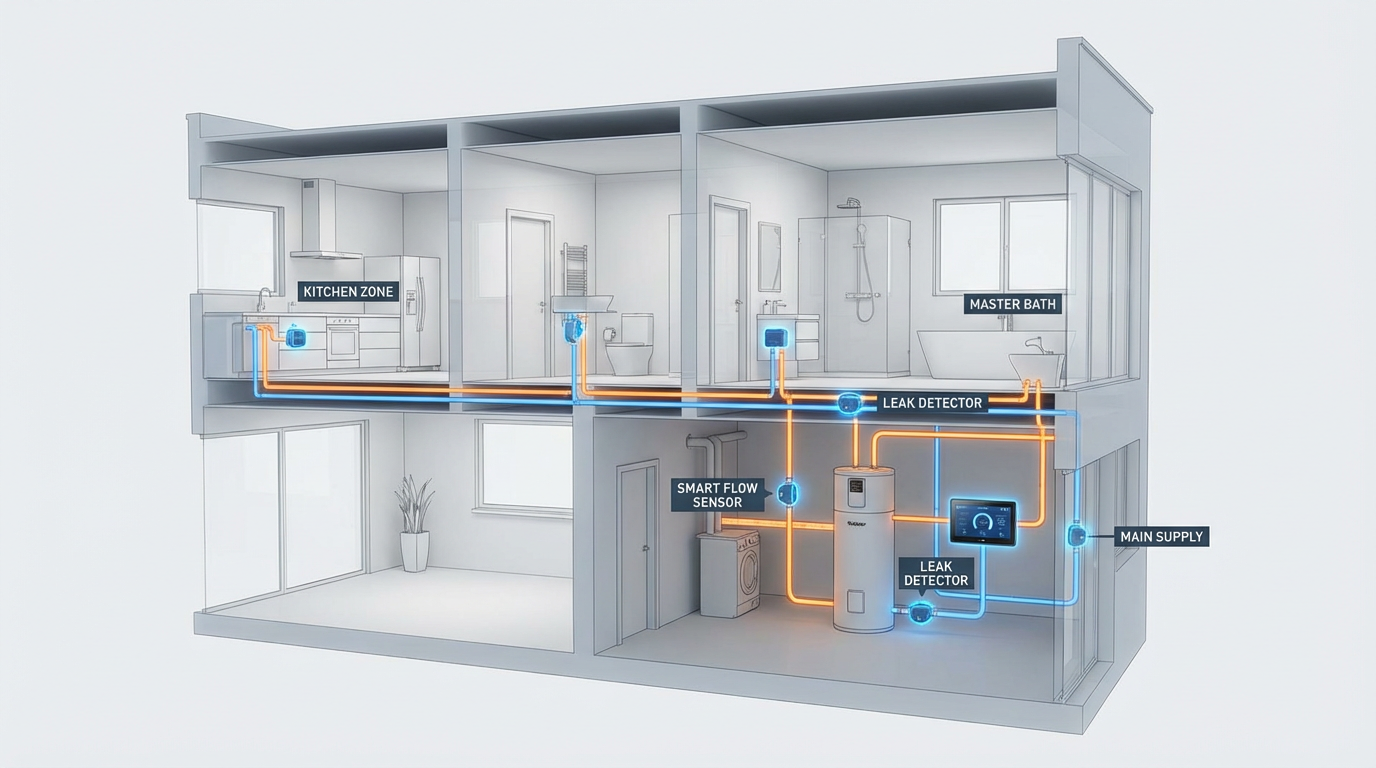
The alternative — manifold or “home-run” plumbing — dedicates a separate small-diameter line from a central manifold to each fixture. Smaller pipes hold less water. Less water means less thermal mass to cool down. Hot water arrives faster, pressure stays stable even when multiple fixtures run simultaneously, and you can isolate any line at the manifold without shutting off the whole house.
But manifold systems use more total pipe footage. And routing dozens of individual lines through framing without crossing each other, kinking at corners, or violating code clearances is genuinely complex. On a hand-drawn plumbing plan — still the industry standard for custom residential work — it’s a spatial puzzle that most plumbers solve by reverting to trunk-and-branch because it’s faster to sketch.
Enter the Algorithm
PipeIt’s Plumbing Copilot is a Revit plugin that automates pipe routing with constraint-based optimization. Define your fixture locations, pipe sizes, slope requirements, and no-go zones. The software calculates clash-free routes through walls, plumbing chases, and ceiling voids — automatically generating P-traps, enforcing elbow restrictions (45° only when code requires it), and linking every parameter back to Revit’s native controls. What takes an experienced drafter two to three hours, the Copilot produces in minutes.
It’s not magic. It’s constraint satisfaction — the same class of algorithm that schedules airline crews and routes circuit board traces. The plumbing version just took longer to arrive because the industry wasn’t asking for it. Residential plumbing design has been the last holdout of pencil-on-paper in an industry where structural, electrical, and HVAC design went digital years ago.
The PEX Advantage AI Exploits
PEX tubing now accounts for over 60% of new residential water supply installations. At $0.40 to $2.00 per foot versus copper’s $2 to $8, PEX has already won on economics. But the real unlock for AI-optimized layouts is PEX’s flexibility.
Copper needs an elbow fitting at every turn. Each fitting is a potential leak point, a flow restriction, and labor time. PEX bends. A well-optimized AI layout can route a home-run line from the manifold to a second-floor bathroom with two or three sweeping curves and zero fittings in the wall cavity. Fewer fittings means fewer leak risks, faster installation, and lower material cost — exactly the kind of multi-variable optimization that algorithms eat for breakfast and plumbers solve with thirty years of intuition.
Smart manifold systems from Uponor add another layer: individual shutoff valves for each line, color-coded connections, and — increasingly — integration with smart water monitors. The manifold becomes a control panel for the entire home’s water supply. Paired with an AI-optimized layout that minimizes line lengths, you get a plumbing system that delivers hot water in seconds instead of minutes.
The DOE Standard Nobody Meets
The Department of Energy’s Zero Energy Ready Home program requires that no more than 0.6 gallons of water be discharged from the farthest fixture before hot water arrives. That’s roughly six seconds of flow from a standard showerhead. It’s an elegant, measurable target.
Almost nobody hits it. Conventional trunk-and-branch layouts in a two-story home routinely discharge 2 to 4 gallons before hot water arrives at distant fixtures — four to seven times the DOE target. Meeting 0.6 gallons requires either a recirculation pump (adding $200–$800 in hardware plus ongoing energy cost) or a plumbing layout specifically designed to minimize line length between heater and fixtures.
That’s an optimization problem. AI-routed manifold layouts, with dedicated ½” lines holding only 0.1 gallons per 10-foot run, can hit the 0.6-gallon target without recirculation hardware on single-story plans and with minimal assist on two-story homes. The savings compound: no pump electricity, no pump maintenance, no check valve to fail at year seven.
Underground: Where AI Prevents Catastrophe
Below the slab is where plumbing mistakes become permanent. Cross-bores — where a horizontal drill punches through an existing sewer lateral — are a ticking time bomb. PG&E has inspected over 250,000 sewer laterals since 2013, generating 30,000 hours of CCTV footage.
SewerAI’s AutoCode now processes that footage with computer vision, identifying cross-bores at 97.5% accuracy versus 80% for manual review — and cutting review time by 70%. For new construction, AI-integrated ground-penetrating radar scans are beginning to map existing utilities before trenching, reducing the chance of creating new cross-bores in the first place.
What AI Can’t Fix
Routing is only half the problem. The other half is the guy sweating joints at 7 AM on a Tuesday. A perfectly optimized plumbing plan can still leak if a crimp ring isn’t fully seated, a slope is wrong, or a vent stack terminates in the wrong place. Automated layout tools don’t yet verify installation quality — that’s still a human inspector with a flashlight and a level.
The bigger gap is adoption. PipeIt runs on Revit. Revit is a commercial MEP tool. The residential plumber doing $4,000–$12,000 rough-ins on custom homes doesn’t use Revit. He uses a pencil, a code book, and experience. Until someone builds an AI plumbing layout tool that runs on a phone — snap the floor plan, get an optimized pipe route with a material list — the technology will stay locked in the commercial world where $50 million hospital projects can justify the software license.
The 300 billion gallons are waiting.
Sources: Premier H2O — Water Wasted Waiting for Hot Water · DOE/PNNL — Efficient Hot Water Distribution (Zero Energy Ready Home) · CMHC — Home-Run Manifold Planned Layouts · PipeIt — Plumbing Copilot (Revit Plugin) · HPAC — Uponor Smart Plumbing & PEX Manifold Systems · Trenchless Technology — PG&E / SewerAI Cross Bore Detection · PlumbingTipsToday — Rough-In Plumbing Costs (2025) · SewerAI — 97.5% Cross Bore Detection Accuracy