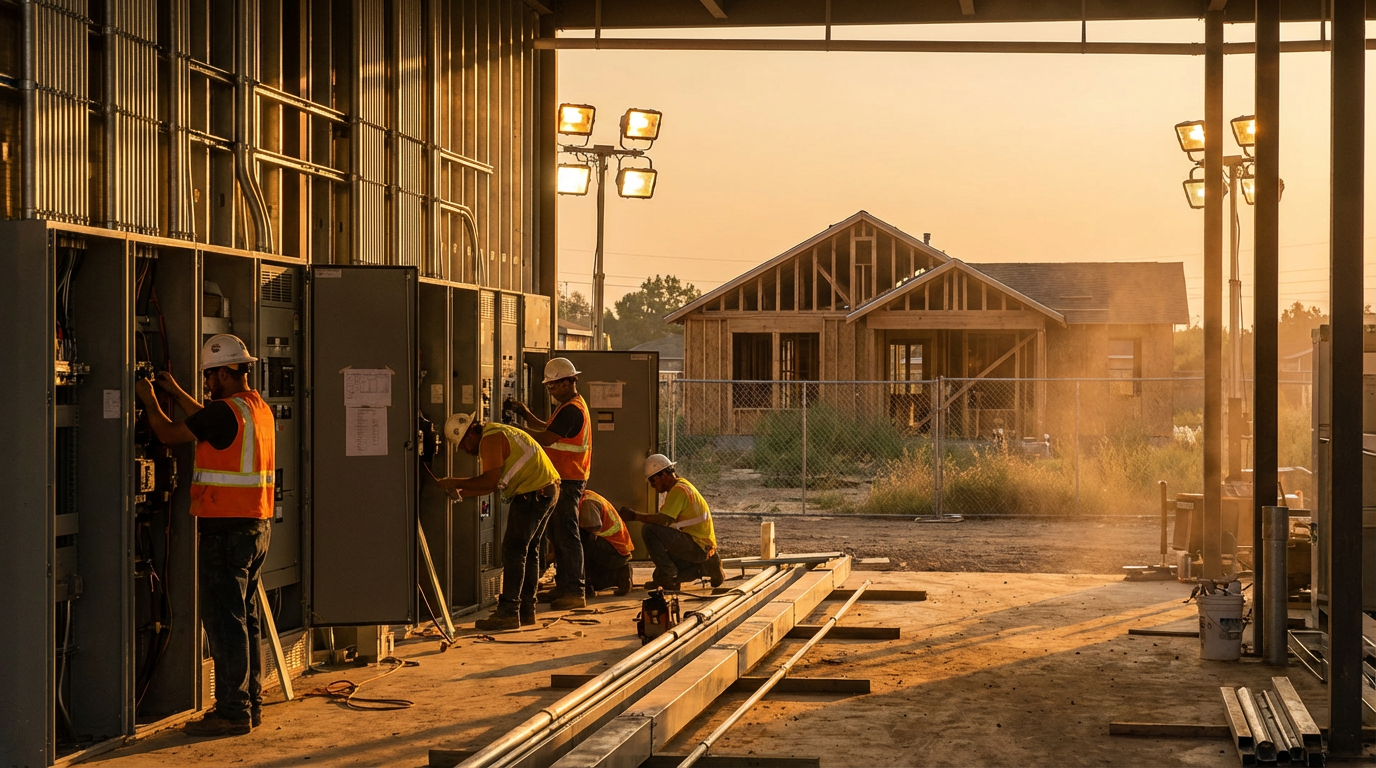
Your electrician isn’t booked for three months because he’s lazy. He’s booked because a data center in Loudoun County offered him $52 an hour, climate-controlled work, and a schedule that doesn’t cancel for rain. He took the job. You’d take it too.
Across America, over 400 data centers are under construction for Amazon, Google, and Microsoft. Each one needs hundreds of electricians, pipe fitters, and HVAC technicians. These are the same workers who wire your panel, run your ductwork, and plumb your bathrooms. And data centers pay 30% more.
That gap isn’t a rounding error. At 2,080 hours per year, it’s $24,960 in extra annual pay. No seasonality, no callbacks from unhappy homeowners, no crawling under houses in July. The rational economic decision for a journeyman electrician is obvious.
The Numbers Nobody Connects
The construction industry is short 439,000 workers. That’s the headline number from the Associated General Contractors, and it gets cited in every housing story. What doesn’t get cited is where those workers went.
Building permits fell 5.8% year-over-year in January 2026, according to Census Bureau data. Data center construction spending surged over the same period. That correlation is not coincidental. When 400+ commercial megaprojects compete for the same labor pool as 1.4 million housing starts, housing loses. It has to. Residential builders can’t match the wages, and 92.1% of them have fewer than 10 employees.
A ten-person framing crew can lose one electrician to a data center project and still function. They can’t lose three. And right now, the DC/Maryland/Virginia electricians’ union alone has doubled its membership to 14,700 since 2018, fed primarily by commercial and industrial recruitment.
The Pipeline Math Is Brutal
America has 762,000 electricians. Roughly 25,000 retire every year. Apprenticeship programs graduate about 30,000 annually. That’s a net gain of 5,000 electricians per year against a Bureau of Labor Statistics projection of 80,000 new positions needed by 2028.
Sixteen years to fill today’s gap. That assumes no acceleration in demand, no additional retirements beyond the current rate, and no further data center expansion. None of those assumptions will hold.
Electrical subcontractor bid prices are already up 18–25% since 2022 in high-growth markets. Residential electricians are booked four to six weeks out for basic service calls. Panel upgrades run three to four months. And the specializations that data centers need most—EV charging, solar integration, high-voltage switchgear—command 15–25% premiums above standard journeyman rates, pulling the most capable workers furthest from residential work.
What This Costs a Home Buyer
When a residential build gets delayed three to six months waiting for electrical labor, the buyer pays for it. Lot carrying costs, construction loan interest, permit extensions, and the opportunity cost of not being in the home. Conservative estimates put that at $12,000 to $24,000 per home.
| Cost Category | 3-Month Delay | 6-Month Delay |
|---|---|---|
| Construction loan interest | $5,000–$8,000 | $10,000–$16,000 |
| Lot carrying costs | $2,000–$4,000 | $4,000–$8,000 |
| Permit extensions/fees | $500–$1,500 | $1,000–$3,000 |
| Rental costs (while waiting) | $4,500–$7,500 | $9,000–$15,000 |
| Estimated total | $12,000–$21,000 | $24,000–$42,000 |
These are conservative ranges. In markets where data center construction is most concentrated—Northern Virginia, central Ohio, the Phoenix metro—delays are running longer and carrying costs are higher.
The Counterargument Is Correct and Irrelevant
Standard rebuttal: data centers create good jobs and economic growth. Housing demand is cyclical. When mortgage rates drop, construction will rebound and workers will follow the money back to residential.
The first part is true. Data center jobs are better jobs for the workers who take them. Nobody should fault an electrician for choosing $52 over $40. As Home Builder Institute CEO Edward Brady warns, though, the shift “could be difficult to reverse.”
Here’s why. An electrician who moves to data center work in 2025 builds commercial relationships, earns commercial certifications, and develops a commercial reputation. By the time residential demand rebounds in 2027 or 2028, that worker has three years of data center experience on their résumé and no economic reason to go back to wiring houses at $40 an hour. The pipeline doesn’t just slow down. It restructures permanently.
Meanwhile, replacing a departing journeyman takes four to five years of apprenticeship. The residential builder who loses an electrician today won’t have a replacement until 2030 at the earliest. For the home buyer waiting on that electrician, the timeline is measured in months of delay and thousands of dollars in carrying costs.
What Could Help
Modular and prefabricated electrical assemblies reduce on-site electrician hours by 30–40%, according to manufacturers like QwickBuild and PlugPlay Electric. If the electrician can’t come to the house, build the house to need fewer electrician hours.
AI-powered scheduling and resource optimization tools like BuildOps and Procore help smaller builders maximize the productive hours of the tradespeople they do have. Route optimization, predictive scheduling, and automated material ordering can recover 10–15% of lost productivity from understaffing.
Neither solution replaces the missing workers. Prefab reduces the number you need. Scheduling software makes the ones you have more efficient. Together, they might shave a month off a six-month delay. That’s meaningful for a home buyer, but it’s not a fix for a 16-year pipeline gap.
Honest Limitations
The 30% wage premium comes from WSJ reporting on data center construction wages versus BLS averages for residential building workers. Actual premiums vary by market and trade. In some regions, the gap is narrower. In Northern Virginia and central Texas, it’s wider.
The $12,000–$24,000 delay cost estimate uses national averages for construction loan rates and carrying costs. Individual experiences range widely depending on lot cost, loan terms, and local permit timelines.
Attributing the entire residential labor shortage to data center poaching overstates the case. Retirement, immigration policy, and chronic underinvestment in trades education all contribute independently. But data center construction didn’t create the shortage. It accelerated it, and it did so by targeting the highest-skilled, hardest-to-replace workers in the residential pipeline.
92% of construction firms report difficulty finding qualified workers. 45% say labor shortages are the leading cause of project delays. The data center boom didn’t start those trends, but it made them structurally worse at exactly the moment housing needed the opposite.