The pitch was intoxicating. Build homes in a climate-controlled factory like you build cars. Ship finished modules to site. Crane them into place. Done in weeks, not months. Katerra raised $2 billion — mostly from SoftBank — on this promise. It filed Chapter 11 in June 2021 with factories half-built and hundreds of projects in limbo. Veev raised $600 million, tried the same vertical integration playbook, and shut down in 2024. The graveyard of prefab dreams is large, expensive, and well-documented.
So why is anyone still trying?
Because the math hasn’t changed. Factory-built homes cost 10–20% less than site-built. Build times drop by 30–50%. Waste falls by up to 90%. And America is still short roughly 4 million homes with 439,000 construction jobs unfilled. What’s changed is the technology inside the factory — and the hard-won lessons from watching predecessors burn through billions.
Why Katerra and Veev Actually Died
The popular story is that modular construction doesn’t work. The real story is more specific and more useful: both companies made the same fatal mistake. They tried to own the entire value chain — lumber mills, architecture, manufacturing, installation, finishing — in an industry where every step requires deep domain expertise and local relationships.
Katerra bought a CLT factory, launched an architecture firm, hired thousands of field workers, and attempted to build everything from start to finish. It was 16 companies crammed into one, most of them hemorrhaging cash. Veev panelized entire homes with embedded plumbing and wiring but couldn’t make the math work outside its initial California market. CB Insights’ post-mortem cited “difficulty scaling to new geographies” and “conservative industry culture” as co-conspirators.
“If it can’t survive a job site, it doesn’t belong on one. But it also needs to survive the spreadsheet. Katerra couldn’t do either.”
The lesson the survivors learned: arm the builder, don’t try to become the builder. Solve one hard problem exceptionally well and plug into existing supply chains.
The AI-Powered Factory Floor
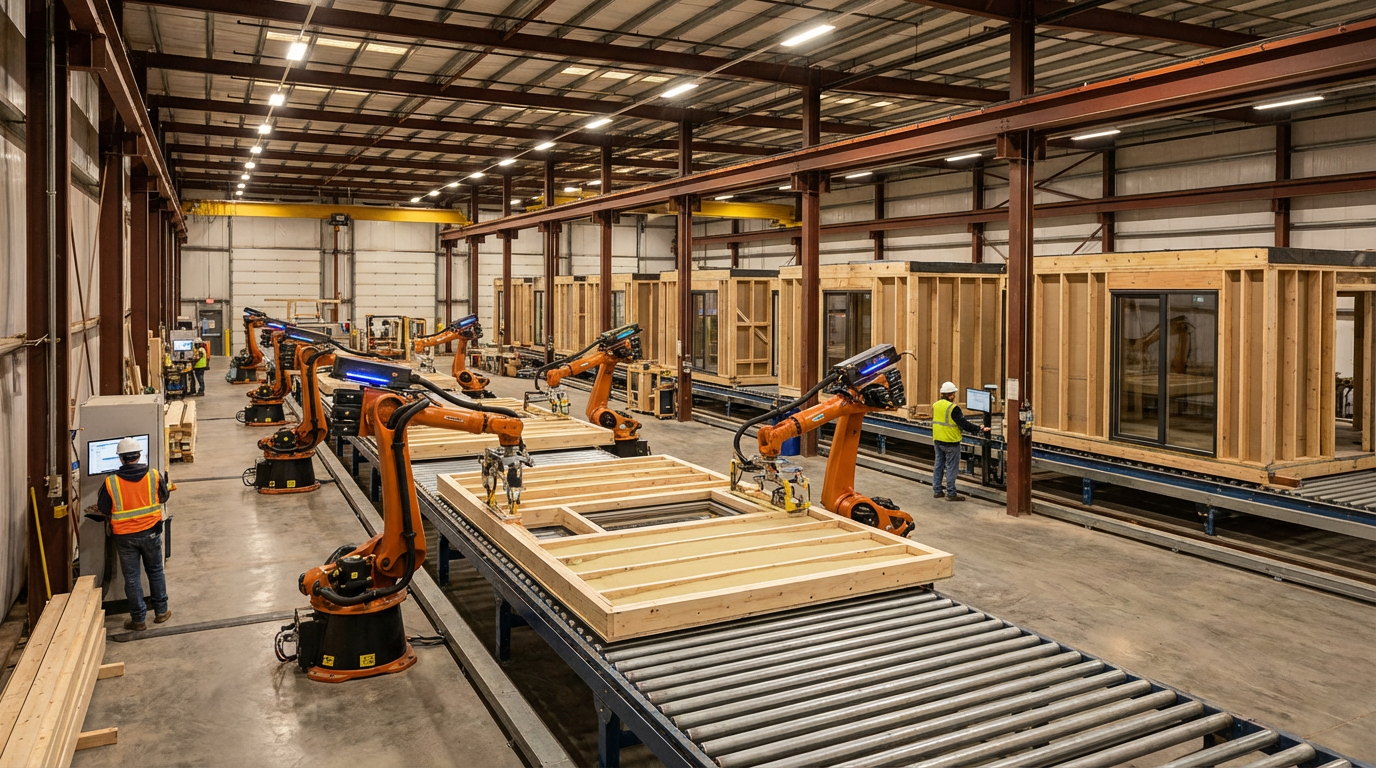
Walk into a next-generation modular factory and the differences from Katerra’s era are immediately visible. Promise Robotics, a Canadian startup, has built what it calls a “Homebuilding Factory-as-a-Service” — compact robotic cells that can prefabricate structural components with AI-driven perception systems that adapt in real time to material variations. A single-family home can be assembled in roughly five hours. A 64-unit apartment building in two weeks. Their robots use machine vision to handle the variability that killed rigid automation systems — lumber that’s slightly warped, dimensions that are off by a millimeter.
KUKA, the German industrial robotics giant, is partnering with Kleusberg on a system deploying five industrial robots to weld more than 2,000 metres of 2D floor and ceiling frames per week, going operational in 2027. This isn’t a startup pitch deck — it’s an automotive-grade robotics company bringing decades of factory automation expertise to construction.
Merlin AI, an AI-powered enterprise platform for modular manufacturers, generates estimates up to 10× faster than manual methods and includes a factory configurator that optimizes production scheduling, material usage, and logistics in real time. “In an industry where time and precision are critical, adopting AI isn’t just about staying competitive,” says co-founder Sneha Kumari. “It’s about setting a new standard for efficiency and scalability.”
Quality Control That Doesn’t Sleep
The old knock on prefab was quality. Some of it was deserved — early modular builders cut corners to hit price points, and the modules showed up with crooked cabinets and walls that didn’t quite meet. AI-powered visual inspection changes this fundamentally.
Computer vision systems now scan every module at multiple production stages, comparing actual dimensions against the BIM model in real time. Deviation tolerances that used to require a foreman with a tape measure are now caught by cameras that measure to the millimeter. Buildots’ hard-hat cameras, originally designed for site monitoring, are being adapted for factory QC — comparing 360-degree captures against the digital twin and flagging discrepancies automatically.
The result is that factory-built modules now routinely achieve tighter tolerances than site-built construction. When you control the temperature, humidity, and every tool on the line, consistency becomes the default rather than the exception.
Cloud Apartments and the Connection Problem
One of modular construction’s persistent engineering challenges is what happens between the modules. Traditional volumetric modules require extensive field labor to connect plumbing, electrical, and HVAC systems — work that erodes the time savings from factory production.
Cloud Apartments, a development company focused on multi-family housing, has redesigned the mechanical, electrical, and plumbing connections entirely. Their patented Cloud Connect system consolidates utility connections into a single standardized connection point per module. Instead of multiple trades spending days making horizontal and vertical connections through corridors, modules essentially plug together. It’s the difference between wiring a custom circuit board and plugging in a USB-C cable.
This matters because field labor inefficiency is where modular projects have historically bled money. 81% of modular adopters cite speed as the primary driver, but that speed evaporates if site assembly takes as long as conventional construction. Cloud’s approach and others like it are attacking the last bottleneck.
The Market in 2026: Cautious but Growing
The US modular construction market hit $20.3 billion in 2024, representing just 5.1% of total construction activity. That’s projected to reach $25.4 billion by 2029. These are real but modest numbers for an industry segment that keeps promising revolution.
The disconnect between potential and penetration is the ghost of Katerra. Lenders are still cautious about modular projects. Appraisers struggle to comp them. Local building departments sometimes don’t know what to do with plans that show modules being craned in rather than framed up. Every jurisdiction has its own code interpretation, and modular factories that serve multi-state markets have to navigate dozens of overlapping regulatory frameworks for every product line.
But the trajectory is clear. Factory shipments are accelerating. ABB and Cosmic Buildings deployed a mobile microfactory in Los Angeles to rebuild fire-damaged homes with robotic automation. The Modular Building Institute reports growing institutional interest. And the companies that survived the Katerra era have leaner operating models, better technology, and the crucial advantage of knowing exactly how their predecessors died.
“Every delay has a root cause. The root cause of modular’s failures wasn’t the concept — it was trying to do everything at once. The survivors do one thing brilliantly and let the supply chain handle the rest.”
What This Means for Home Buyers
If you’re building a home in the next three to five years, modular is increasingly worth considering — not because it’s cheap (it’s competitive, not always cheaper) but because it’s predictable. A factory doesn’t have rain delays. It doesn’t lose two weeks because the framing crew got pulled to another job. Your kitchen cabinets don’t warp because they sat in an unfinished house through a humid summer.
The biggest practical obstacle remains finding a modular builder who serves your area. Unlike 3D printing or robotic bricklaying, which can theoretically go anywhere, modular homes need to be transported from the factory. Oversize load regulations, highway bridge clearances, and shipping distance all constrain the market radius of any given factory. Most modular manufacturers serve a 300–500 mile radius, which means coverage is still spotty.
But the AI-powered factory model is inherently replicable. Once Promise Robotics or KUKA proves a production cell works, the same system can be deployed in a new facility in a new region. That’s the real promise of bringing automotive-grade automation to homebuilding — not one mega-factory, but a network of smaller, smarter factories closer to where the homes are needed.
The graveyard of modular startups is a cautionary tale. The factories humming to life in 2026 are the next chapter. This time, the robots are smarter, the ambitions are more focused, and the lessons are paid for in someone else’s billions.