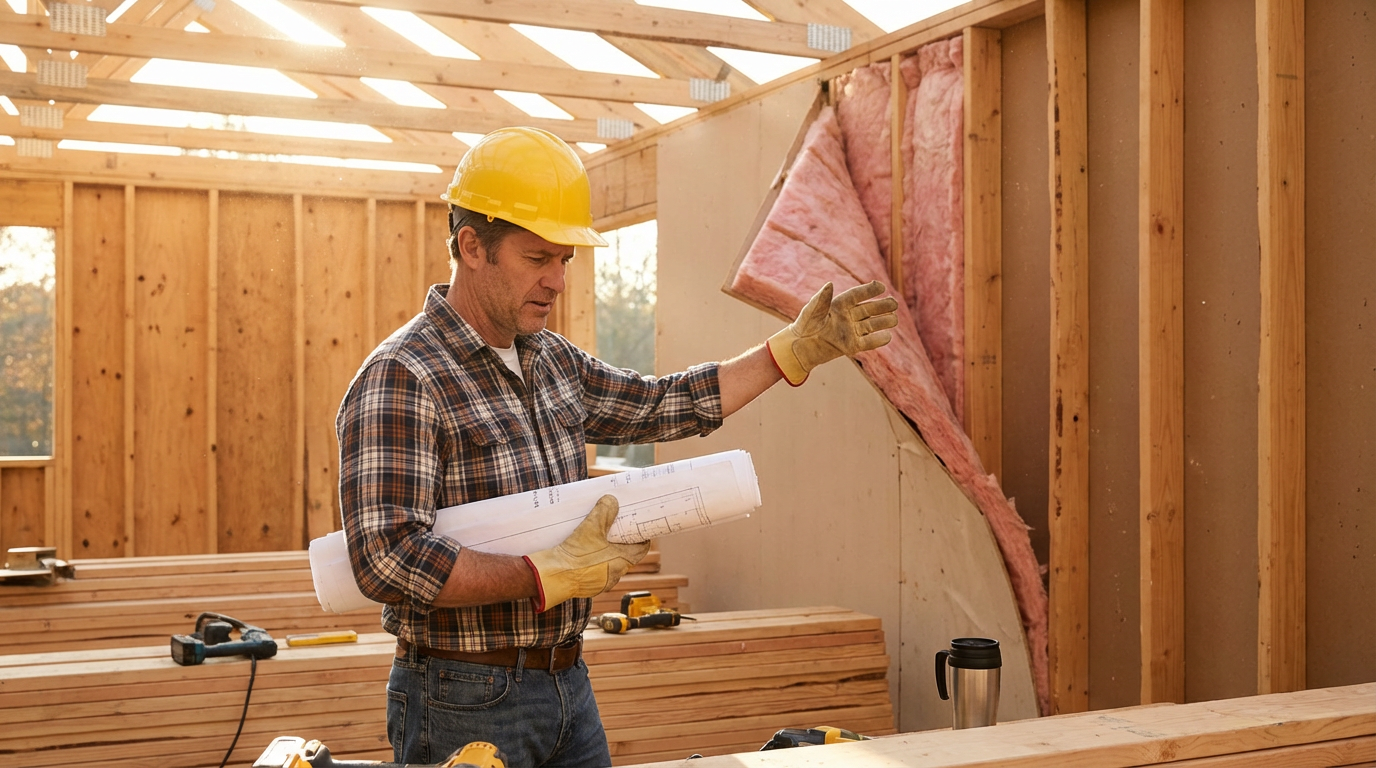
Eight thousand three hundred dollars. That’s the average cost of a single rework event in construction, according to research compiled by the Construction Industry Institute. Not a catastrophic structural failure. Not a foundation crack. One mistake caught after it was already built: a HVAC trunk line routed through a structural header, a bathroom roughed in three inches off the plan, a window opening framed to a spec that was revised two weeks ago. Tear it out. Redo it. $8,300 and 3.4 days, gone.
Multiply that across an industry where 5 to 10% of every project’s budget goes to rework, and you start to see the shape of the problem.
Where 52% of the Money Goes
A PlanGrid/FMI study from 2018 surveying 599 construction leaders found that the US construction industry burns $31.3 billion annually on rework caused by miscommunication and inaccurate project data. That figure covers all construction sectors: commercial, industrial, infrastructure, and residential. Adjusted for construction-cost inflation since 2018 (roughly 35% through 2025, per ENR’s Construction Cost Index), the current figure is likely north of $42 billion. Nobody had pulled the residential portion out on its own.
So we did the math.
CII’s multi-decade research puts rework at 5 to 10% of project cost. The NAHB and Census Bureau put the average new-home construction cost at $323,026 for a 2,000-square-foot house in 2025 (excluding land). Five percent of $323,026 is $16,151. Ten percent is $32,303.
At 1.5 million housing completions per year (Census Bureau, 2024), that’s $24 billion to $48 billion in residential rework annually. Far more than the $31.3 billion all-sectors figure that gets cited in every industry report. Residential construction’s rework bill has been hiding inside a number that made it look smaller than it is.
Now look at where it comes from. CII broke rework into root causes across decades of project data: 52% stems from design errors and omissions. Not bad lumber. Not lazy crews. Drawings that conflicted with each other, dimensions that didn’t match between architectural and structural sheets, MEP systems routed through spaces that don’t physically exist. Another 26% comes from coordination failures between trades. A plumber roughs in before the electrician finishes because nobody updated the schedule. The framer builds to revision B while the trim carpenter has revision D.
Only about 7% of rework is purely field error. The guy on the ladder with the nail gun isn’t the problem. The information he was handed is.
The 1-10-100 Rule
Construction has its own version of the old quality-engineering maxim. Catch an error during design and it costs $1 to fix. Catch it during construction and it costs $10. Catch it after the homeowner moves in and it costs $100.
The numbers aren’t hypothetical. WarrantyWeek’s 2025 analysis of 22 publicly traded homebuilders shows warranty claims paid totaling $1.071 billion in 2024. Per-home accruals vary wildly by builder: NVR reserves $2,662 to $4,447 per home sold. KB Home runs $2,680 to $3,277. Century Communities gets away with $944 to $1,132. That spread tells you something: the builders with tighter QA processes during construction pay less fixing problems after.
Add warranty costs to construction rework and the total per-home quality tax climbs further. A builder at the high end of the rework range ($32,000) with NVR-level warranty accruals ($4,447) is carrying $36,447 in mistake costs per home. On a $400,000 sale, that’s 9.1% of the buyer’s purchase price going to errors. Not to better materials. Not to better design. To doing things twice.
$1,080 Per Question
Requests for information, RFIs, are how the job site asks the architect or engineer to clarify something on the drawings. According to a Navigant/Guidehouse construction analysis, each RFI costs $1,080 to process and takes a median 9.7 days to get a response. On a typical residential project that generates 20 to 40 RFIs, that’s $21,600 to $43,200 in administrative cost and 6 to 13 months of cumulative wait time, just asking questions the drawings should have already answered.
Most RFIs exist because the drawings are ambiguous, incomplete, or conflicting. A dimension doesn’t close. A detail on sheet A-4 contradicts a section on S-2. A specification calls for a product that was discontinued last year. Every one of those is a design-phase catch that became a construction-phase cost.
What Catches Errors Before They’re Built
Articulate, an AI-powered drawing analysis platform, claims its system catches three times more issues than manual plan review. It processes hundreds of pages of construction documents in minutes, cross-referencing architectural, structural, and MEP drawings for dimensional conflicts, code violations, and specification mismatches. When a beam callout on the structural sheet doesn’t match the clearance on the architectural plan, the software flags it before anyone pours concrete.
Clash detection platforms like Procore and BIM 360 work the 3D model rather than 2D drawings. On a $355 million project cited by PlanRadar, proactive clash detection identified roughly 2,000 conflicts between trades and prevented an estimated $3.4 million in rework. That’s a 10x return on the coordination investment. Scale it down to residential and the absolute numbers shrink, but the ratio holds: catching a $500 duct-versus-joist conflict in the model costs almost nothing compared to ripping out drywall to fix it in the field.
A PlanRadar survey of 811 construction professionals across 13 countries found that firms running consistent QA and quality-control programs keep rework below 5% of project cost 56% of the time. Firms without those standards only hit that mark 37% of the time. More tellingly, companies with strong QA programs are 25 to 28% more likely to achieve profit margins above 3%. In an industry where 3% margins are considered healthy, the quality investment pays for itself in profitability, not just avoided rework.
“Every House Is a Prototype”
Builders push back, and they have a point. Unlike a factory floor where you stamp out identical widgets, every house is assembled in variable field conditions by rotating crews on a unique lot. Wind, rain, soil conditions, material availability, subcontractor scheduling. A framer who builds 200 houses a year will still occasionally misread a dimension on the plan because he’s working from a phone screen in direct sunlight with a 20-mph crosswind. Some rework is the cost of building physical things in the real world.
Fair enough. But 52% of rework comes from design errors, not field conditions. A dimensional conflict between the architectural and structural drawings exists regardless of the weather. An HVAC layout that routes a trunk through a load-bearing wall is wrong in sunshine and in rain. That half of the rework bill is entirely addressable with better drawing coordination, and AI plan review tools are specifically designed to attack it.
If you can cut just the design-error portion, you save $8,000 per home. At 1.5 million homes a year, that’s $12 billion in annual residential rework that’s eliminable without changing anything about how crews work in the field.
And the field-error half isn’t untouchable. Computer vision monitoring platforms like Buildots and OpenSpace are designed to catch installation mistakes while walls are still open, before drywall covers them and turns a $200 fix into a $2,000 warranty callback. We covered these tools in a separate investigation. The technology is real but adoption is early.
None of this is speculative. The errors are known. The cost is quantified. The tools exist. What hasn’t changed is the standard practice: most residential projects still review plans manually, coordinate trades by phone, and catch mistakes when a framer says “this doesn’t look right.” Sixteen thousand dollars a house, 1.5 million houses a year. The industry can keep paying that tax or stop.
The Math, Honestly
We built the $24 to $48 billion estimate from three published inputs:
Input 1: CII research puts construction rework at 5 to 10% of total project cost, based on studies spanning 1991 to 2024 across commercial, industrial, and residential sectors. We applied this range to residential specifically.
Input 2: NAHB and Census Bureau data put average new-home construction cost at $323,026 for a 2,000-square-foot home in 2025, excluding land costs. Five percent of $323,026 is $16,151. Ten percent is $32,303.
Input 3: Census Bureau housing completions totaled approximately 1.5 million single-family units in 2024.
Result: $16,151 to $32,303 per home, multiplied by 1.5 million completions, yields $24.2 billion to $48.5 billion in annual residential rework.
We then cross-checked against WarrantyWeek’s per-home warranty accrual data ($2,662 to $4,447 per home) as a floor: warranty costs represent only the rework that survives construction and shows up after occupancy. Warranty accruals running 8 to 14% of our rework estimate is consistent with a system where most rework gets caught and fixed during construction, with a smaller portion escaping to the homeowner.
Limitations
CII’s 5 to 10% rework rate was established across all construction types, not residential specifically. Residential projects tend to be simpler than commercial or industrial work, which could push the rate toward the lower end. Production homebuilders building the same floor plan hundreds of times likely experience lower rework rates than custom builders. We applied the full range to capture this uncertainty.
The $323,026 average construction cost is a national figure. Regional variation is enormous: building in San Francisco costs roughly double what it costs in Houston. Rework rates may also vary regionally based on labor market tightness, inspection rigor, and builder scale.
Articulate’s claim of catching three times more issues than manual review comes from the company itself. Independent, peer-reviewed validation of AI plan review accuracy in residential construction is, to our knowledge, not yet published. Similarly, the PlanRadar QA/QC survey is a self-selected sample of professionals who opted into a vendor’s survey.
Production builders using repeatable floor plans, factory-built components, or modular construction may already operate well below the 5% rework floor. Our estimate captures the broad market, not the best-in-class operators.
This article was produced with AI research assistance. All sources, calculations, and claims were verified against the cited primary documents.
Sources
- Construction Industry Institute (CII) — Multi-decade rework research: 5–10% of project cost, $8,300 per event, 3.4-day average resolution, 52% from design errors
- PlanGrid/FMI 2018 Study — $177.5B in non-optimal activity, $31.3B in rework from miscommunication; 599 construction leaders surveyed. 2018 figures; inflation-adjusted estimate ~$42B+ in 2025
- PlanRadar QA/QC Impact Report 2025 — 811 professionals, 56% with QA keep rework <5%, 25–28% more likely to exceed 3% margins; $355M clash detection case study
- WarrantyWeek 2025 Homebuilder Report — 22 builders analyzed, $1.071B total warranty claims (2024), per-home accruals $2,662–$4,447
- NAHB / Census Bureau — Average new-home construction cost $323,026 (2,000 sq ft, 2025), 1.5M annual housing completions
- Articulate — AI plan review catches 3x more issues than manual review, hundreds of pages in minutes
- Navigant/Guidehouse RFI Analysis — $1,080 per RFI to process, 9.7-day median response time