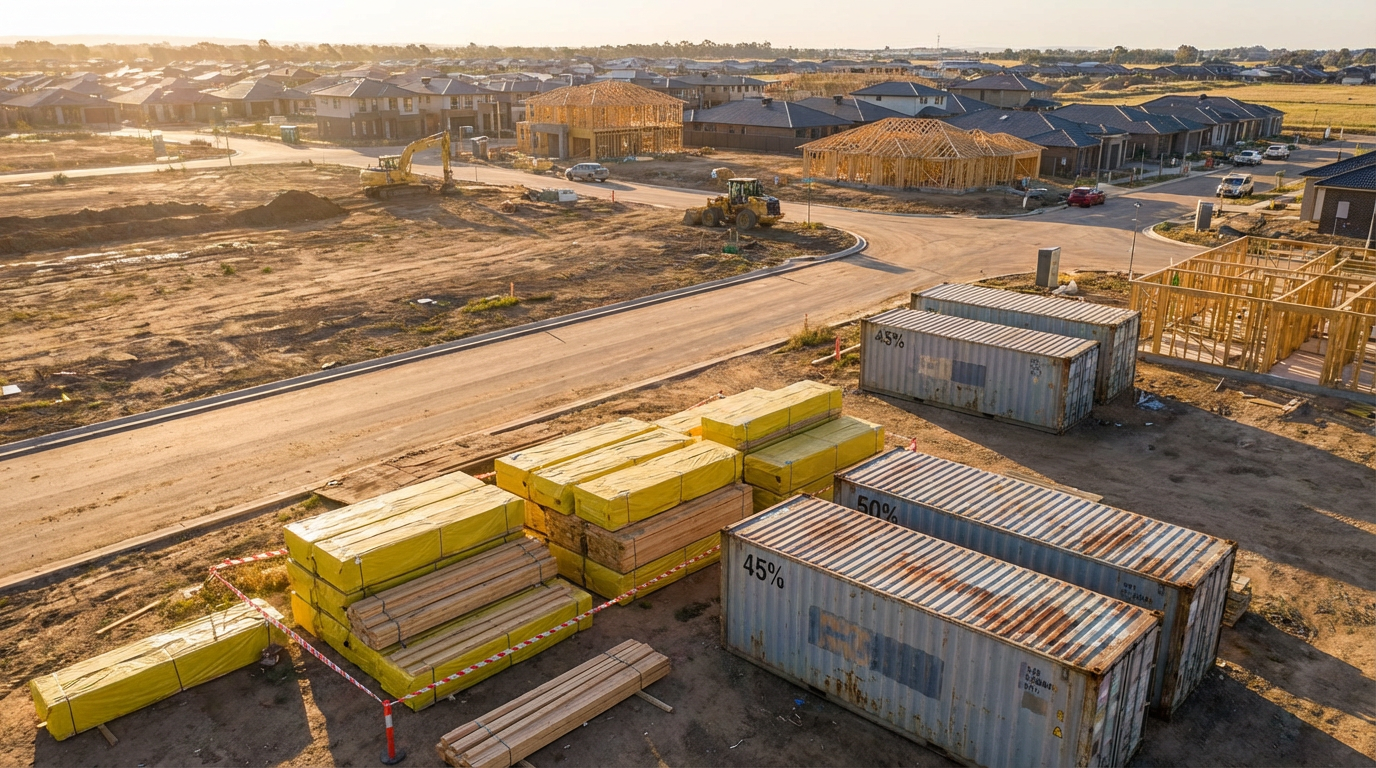
$10,900. That is what tariffs add to the cost of every new single-family home in America, according to builders surveyed by the National Association of Home Builders in April 2025. Builders writing checks for lumber, steel, and cabinets, reporting what they actually paid.
NAHB separately publishes a priced-out model calculating how many households lose purchasing power with each $1,000 increase in home price: 115,593 families per thousand dollars, at current mortgage rates and income distributions.
Multiply. $10,900 in tariff costs × 115,593 households per $1,000 = 1,259,964 families priced out of homeownership by trade policy alone.
Nobody in the policy debate has published this specific number. The inputs are public. The math is simple. Tariffs have priced more than a million families out of a new home, and neither the builders paying the surcharges nor the buyers absorbing them voted for this.
Where the Tariffs Stack
Building material costs have risen 34% since December 2020. Tariffs explain a portion of that, concentrated in five categories that touch every new home built in America.
| Material | Tariff Rate | Legal Authority |
|---|---|---|
| Canadian softwood lumber | 45% combined | 35% antidumping/CVD + 10% Section 232 |
| Steel and aluminum | 50% | Section 232 (doubled June 2025) |
| Chinese kitchen cabinets | 25%–50% | 25% rising to 50% on Jan 1, 2026 |
| Gypsum (drywall) | 10%+ | Section 122 (replaced IEEPA); >50% of imports from Canada/Mexico |
| Home appliances | Varies | Prices rising 2× overall inflation rate (Brookings, Oct 2025) |
Of the $204 billion in goods used for new residential construction in 2024, approximately $14 billion was imported. That 7% share sounds small until you look at what it contains: Canada supplies 85% of US softwood lumber imports, representing roughly 25% of total domestic lumber consumption. The US imports 25% of its steel and 40% of its aluminum. Chinese manufacturers hold a dominant share of the kitchen cabinet market at the entry-level price point where first-time buyers shop.
The "Only 7%" Argument
The most common defense of these tariffs in the housing context runs like this: if 93% of building materials are sourced domestically, how much damage can a tariff on the remaining 7% really do?
More than 7% worth. The mechanism is straightforward: when you impose a 45% tariff on Canadian lumber, domestic lumber producers don't hold their prices out of patriotic restraint. They raise them, because the competitive ceiling just moved up 45%. The tariff doesn't only tax the imported product. It reprices the entire category.
This is not theory. NAHB's builder survey captures the all-in effect. The $10,900 figure includes both direct import costs and domestic price increases driven by reduced competition. Over 60% of surveyed builders reported higher costs attributable to tariffs, and these are builders purchasing primarily domestic materials.
A Brookings Institution/Tax Policy Center analysis from October 2025 provides independent confirmation: their tariff model calculates approximately $30 billion in added residential investment costs nationwide. Divide by roughly 1.4 million housing starts per year and you get about $21,400 per unit. For single-family homes alone (about one million starts), the per-unit figure runs higher, consistent with NAHB's $10,900 builder-reported number for single-family construction only.
The Supreme Court Changed the Legal Framework. The Tariffs Stayed.
On February 20, 2026, the Supreme Court struck down tariffs imposed under the International Emergency Economic Powers Act, ruling that IEEPA lacked congressional authorization for trade measures. Customs stopped collecting IEEPA-based tariffs immediately.
Within days, the administration replaced them under Section 122 of the Trade Act of 1974, which authorizes the president to impose tariffs up to 15% for 150 days. The legal clothing changed. The cost to builders didn't.
Section 232 tariffs on steel and aluminum (50%) remain entirely unaffected by the ruling. Antidumping and countervailing duties on Canadian softwood lumber (35%) continue under their own statutory authority. The tariffs that hit housing hardest were never IEEPA tariffs to begin with.
What AI Procurement Could Recover
If the tariffs aren't going away, the question becomes whether builders can work around them. AI-powered procurement tools offer one path: automated supplier discovery, real-time tariff scenario modeling, and material substitution analysis.
Suplari and similar platforms let procurement teams run natural language queries against supplier databases: "Show me alternative framing lumber suppliers outside high-tariff countries with delivery to the Pacific Northwest." Handoff.ai publishes material-by-material cost comparisons between domestic and imported options, updated as tariff rates change.
Based on published case studies from Suplari and Handoff.ai (vendor sources, worth noting), AI-optimized procurement could realistically recover $2,200 to $3,800 per home, or 20–35% of the tariff exposure. That would bring 254,000 to 440,000 families back into affordability range using the same priced-out model, but still leaves 820,000 to 1,005,000 priced out.
The Adoption Problem
According to a December 2025 survey by ASCE and Bluebeam of 1,000 AEC professionals, only 27% use AI in any operational capacity. Among that 27%, 94% plan to increase usage in 2026. But 73% haven't started.
The picture for residential builders specifically is almost certainly worse. A Siana/RICS compilation of industry adoption data shows 45% of construction organizations have no AI implementation at all. Another 34% are in early pilot. Only 1% have organization-wide integration.
| AI Adoption Stage | Share of Construction Firms |
|---|---|
| No implementation | 45% |
| Early pilot | 34% |
| Regular use (specific processes) | 12% |
| Multi-process implementation | 8% |
| Organization-wide integration | 1% |
Top barriers: lack of skilled personnel (46%), integration with existing systems (37%), data quality concerns (30%), and high implementation costs (29%). For a small-volume homebuilder running ten projects a year, enterprise procurement AI that costs $50,000 to deploy doesn't pencil against $22,000 to $38,000 in annual tariff savings. The math works for a production builder doing 500 homes. It doesn't work for the builder doing 15.
Meanwhile, 52% of AEC firms still use paper during the design phase. 49% use paper during planning. 43% rely on physical signatures. The industry that most needs AI-powered procurement is the industry least equipped to adopt it.
What This Means in Practice
A builder in Phoenix breaking ground on a $420,000 starter home faces $10,900 in tariff costs baked into materials before the first truck arrives. An AI procurement tool could shave $2,200 to $3,800 off that figure by identifying lower-tariff steel from Brazil instead of China, or specifying domestic red oak cabinets priced only 8% above the tariffed Chinese equivalent rather than 25% above. That brings the tariff hit down to $7,100 to $8,700.
Still enough to price out roughly 820,000 to 1,005,000 families. Better than 1.26 million. Not good.
And that scenario assumes the builder has adopted AI procurement tools, which 73% have not. For the majority of American homebuilders, the full $10,900 lands on every home, every buyer, with no mitigation strategy beyond hoping costs come down.
Honest Limitations
NAHB's $10,900 is a survey estimate from builders self-reporting tariff exposure. It is not an audited line-item accounting. Builders may overestimate (attributing some non-tariff inflation to tariffs) or underestimate (missing upstream price effects). The Brookings $30 billion figure provides a useful cross-check but uses a different methodology and scope.
The priced-out model assumes marginal buyers at the affordability edge. In practice, some of these 1.26 million families would be priced out by other cost increases even without tariffs. The number represents the tariff-attributable share, not the total shortfall.
AI procurement savings of 20–35% are estimated from available tool capabilities and published case studies, primarily from commercial and industrial construction. Residential builders buying smaller volumes may achieve lower savings due to weaker negotiating leverage and fewer substitution options.
The AI construction market is projected to grow from $5.3 billion in 2026 to $24.5 billion by 2032 (25% CAGR, per Siana/RICS data). Whether that growth reaches small residential builders, or concentrates among large commercial firms, will determine whether procurement AI becomes a real affordability tool or a competitive advantage reserved for production builders.
Trade policy priced out 1.26 million families. Technology could bring some of them back. Right now, the families most affected have the least access to either solution.