In July 2025, the California Department of Insurance approved its first wildfire catastrophe model. Nobody threw a party. Nobody outside the actuarial community even noticed, which is remarkable given that this single regulatory decision will reshape insurance pricing for roughly two million homes in wildfire-prone zones across the state. Insurers can now set residential premiums using forward-looking wildfire risk projections instead of historical loss data alone, and the ruling requires them to factor in something they had been free to ignore for decades: whether you actually did anything to protect your house from burning down.
That last part matters. It matters enormously, because until last year the math was broken in a way that punished the people who tried hardest. You could spend $15,000 replacing your attic vents with ember-resistant models, ripping out bark mulch and putting down gravel, installing metal gutter guards, clearing every scrap of vegetation within five feet of your walls. All of it. And your premium would reflect none of it, because the catastrophe models that generated your rate simply did not have an input field for home hardening. Your zip code determined your price, and your effort was invisible.
Now there is a number. In April 2026, the California Department of Insurance and the National Association of Insurance Commissioners released a landmark study quantifying exactly what home hardening does to a community's insurance risk profile. Using the Moody's wildfire catastrophe model, researchers analyzed nearly 30,000 homes within the burn perimeters of the January 2025 Palisades and Eaton fires. Rebuild those homes to the Insurance Institute for Business and Home Safety's Wildfire Prepared Home Base standard, and Average Annual Loss drops 31 percent. Meet the more stringent Plus standard, and the reduction reaches thirty-five percent.
Average Annual Loss is the single most important metric in an insurance rate filing. It drives everything: whether an insurer will write a policy in your neighborhood at all, and if so, at what price. A 31 percent reduction in AAL does not automatically translate to a 31 percent premium cut. Insurers fold other variables into pricing, from reinsurance costs and administrative overhead to profit margins, but the CDI study establishes a ceiling that did not exist before. Your hardened home is now, by the regulator's own modeling, a measurably different risk than the unretrofitted one next door.
What $15,000 Actually Buys
Headwaters Economics, a Montana-based research organization that partnered with IBHS to develop retrofit cost estimates, breaks the tiers down cleanly for a typical 2,000-square-foot California home.
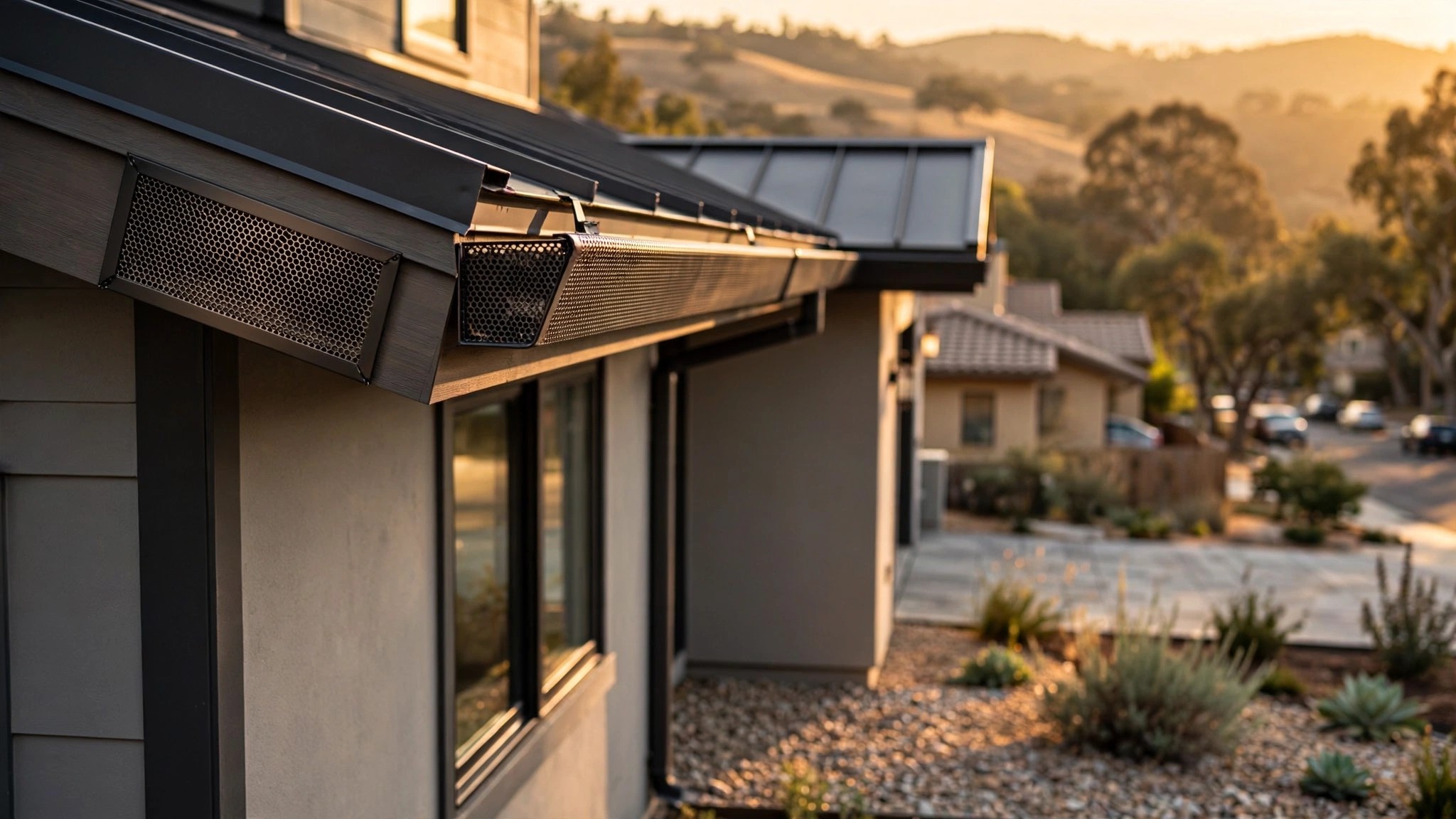
Two thousand dollars is the low end: metal flashing at every deck-to-wall and roof-to-wall intersection, blocking one of the most common ember entry points. Spend $10,000 to $15,000 and you assemble the full ember defense package: ember-resistant vents replacing every attic and crawlspace opening, metal gutter guards, bark mulch swapped for gravel within five feet of the foundation, 1/8-inch metal mesh screening over any remaining opening that fire could exploit. This tier aligns roughly with the IBHS Base standard, the one that produced the 31 percent AAL reduction in the CDI study, which means that for somewhere between ten and fifteen thousand dollars a California homeowner can purchase the specific set of upgrades that the regulator's own catastrophe model associates with a nearly one-third reduction in expected wildfire losses.
Go further and the costs escalate fast, with full replacement of every exterior component with top-rated wildfire-resistant materials runs up to $100,000: dual-pane tempered windows, noncombustible siding, enclosed eaves, covered gutters. Roof replacement alone, the single most expensive line item because of the labor and material volume involved, costs approximately $22,000 for the model home. Many of those materials carry longer lifespans and lower maintenance demands than conventional options, though, compressing the effective cost difference over a 20-year ownership period.
| Retrofit Tier | Approximate Cost | What It Covers |
|---|---|---|
| Minimal | $2,000 | Metal flashing at wall intersections |
| Ember defense (Base) | $10,000 – $15,000 | Vents, flashing, gutter guards, mulch swap, mesh |
| Radiant heat (Plus) | $40,000 – $100,000 | Windows, siding, eaves, full roof, fencing |
For new construction in wildfire-prone areas, the marginal cost is far smaller. KB Home broke ground on Dixon Trail in Escondido, a 64-home community built entirely to the Plus standard, which is the first designated Wildfire Prepared Home Neighborhood in the country. Commissioner Ricardo Lara's office estimates the marginal cost of meeting WPH Plus on new construction at roughly 3 percent per home, a figure so small relative to California land and construction costs that it barely registers in a pro forma. On a $750,000 new build in a San Diego suburb, that is $22,500 in additional materials and detailing that buys a 35 percent AAL reduction for every owner who will ever live there.
What the Data Shows About Homes That Survive
Five fires. Tubbs. Thomas. Camp. Kincade. Glass. Researchers at UC Berkeley led by professor Michael Gollner ran a machine learning analysis of post-disaster ground surveys across all five, covering thousands of structures in California's wildland-urban interface. Two numbers tell the full story: homes with both hardened building materials and defensible space survived at a rate close to 50 percent, while homes with nothing managed just twenty.
One variable dominated everything else: just the first five feet. Clearing vegetation within five feet of the house, what fire scientists call Zone 0, reduced structure losses by 17 percent across the entire dataset, a number that outweighed every other hardening measure in the study and that costs almost nothing to achieve. During the conflagration conditions that characterize the worst California fires, vegetation that close to a structure dried out in minutes, turned into tinder, and created rapid ignition pathways that no building material upgrade could overcome on its own. Gravel is not exciting, and it is not a technology product that requires an app or a subscription or a sales demo. But it works. It works because fire needs fuel, and the gap between your wall and the nearest shrub is the cheapest variable in the entire equation.
After Paradise burned in 2018, the data got sharper. Much sharper. Camp Fire destroyed more than 18,000 structures in a few hours, but nearly 40 percent of homes built after 1997, when California first adopted wildland-urban interface building standards, survived. For homes built before that year: 11 percent. Twenty-nine percentage points of survival separated two houses on the same street because one had a Class A roof and ember-resistant vents, and the other had a wood-shake roof and open soffits.
Who Pays When Nobody Hardens
California's FAIR Plan, the insurer of last resort for homeowners who cannot get coverage in the competitive market, carried $650 billion in total exposure as of June 2025. Read that number again: six hundred and fifty billion dollars, a 289 percent increase in four years. Every homeowner who cannot get private insurance ends up on the FAIR Plan, which was designed as a narrow backstop but has become a systemic risk that the state's insurance infrastructure was never built to carry, and whose capacity to absorb a major loss event at its current size remains functionally untested. FAIR Plan premiums are higher and coverage is thinner.
Under the new catastrophe modeling rules, insurers who use forward-looking models must commit to writing at least 85 percent of their statewide market share in wildfire-distressed areas. That is the bargain: charge more realistic rates that reflect actual risk, but sell policies to the people who need them most. Travelers, one of the first carriers to file under the framework, is seeking a 6.9 percent rate increase for single-family homes while specifically flagging wildfire-hardened homes with defensible space as eligible for preferential treatment.
Paradise offers the clearest preview. After adopting the IBHS standard as its rebuilding benchmark and pairing it with FEMA Hazard Mitigation Grant Program funding for retrofits, the town has seen private insurers begin returning. Some residents have seen their insurance costs drop dramatically after transitioning from FAIR Plan pricing back to the competitive market, which suggests that the combination of community-level hardening and insurer re-entry can compress premiums in ways that no individual retrofit achieves on its own. Individual results will vary by carrier and by home, but the directional signal is unambiguous: hardening your house does not just make it less likely to burn. It makes it insurable.
Why the Insurance Math Still Has Gaps
Thirty-one percent AAL reduction sounds clean, but several caveats deserve the same weight as the headline number. Too clean, actually.
First, there is only one model. The CDI-NAIC study used Moody's catastrophe model to produce its estimates. Other approved models, each built on different assumptions about fire behavior, fuel accumulation, and structure vulnerability, could yield different numbers for the same set of hardened homes. No cross-model comparison has been published, and the 31 percent figure carries the authority of a single vendor's methodology, not a consensus.
Second, AAL is not your premium. An insurer's rate includes layers beyond expected loss: expense load, reinsurance cost, profit margin, regulatory compliance overhead. A homeowner who reduces their property's AAL by 31 percent should expect a meaningful but smaller premium reduction, and no insurer has publicly disclosed the premium discount corresponding to WPH Base or Plus certification, which means the consumer-facing payoff of that $15,000 retrofit remains an estimate rather than a guarantee backed by published rate schedules.
Third, your neighbor matters. The study modeled community-wide adoption, every home in the burn perimeter meeting the standard, where the collective benefit of breaking the home-to-home ignition chain amplifies each individual retrofit. Harden your house while your neighbor leaves theirs untouched, and your risk reduction is real but diminished, because radiant heat from the adjacent structure can still overwhelm your upgrades.
Fourth, vegetation grows back. The CDI study itself notes that wildlands surrounding the Palisades and Eaton fire zones will regrow to critical fuel load within approximately 10 years. Defensible space is not a one-time capital expenditure but a recurring obligation, every fire season, for the life of the home, which means the total cost of ownership in a wildfire zone extends far beyond the initial retrofit check.
What to Do With This
If you own a home in a California wildfire zone and your insurance is through the FAIR Plan or your premiums feel disconnected from the risk you have actually mitigated, the new modeling framework gives you a tool that did not exist two years ago. Your hardening improvements are now visible to the catastrophe models that generate your rate. Use that.
Start with the highest-impact interventions first: clear vegetation within five feet of every exterior wall, replace bark mulch with gravel, and install ember-resistant vents or cover existing ones with 1/8-inch metal mesh. Total cost runs between $2,000 and $5,000. These measures target the Zone 0 perimeter that UC Berkeley's analysis identified as the single most predictive variable in whether a home survives a wildfire, and they require no specialized contractor, no permit application, and no technology more sophisticated than a shovel and a trip to the hardware store. Then install metal flashing at every deck-to-wall intersection, blocking a second common ember entry point at trivial additional cost.
Building new? Specify WPH Plus from the start, because at 3 percent marginal cost, it is the cheapest meaningful insurance arbitrage available in California residential construction right now. Twenty-two thousand five hundred dollars on a $750,000 home buys a 35 percent AAL reduction that will compound over every year of every owner's insurance payments for the life of the structure.
If you are a builder working in wildfire-prone communities, the case is structural now. Not aspirational. Insurers filing under the new catastrophe modeling framework are required to give credit for hardening, and the homes you build to WPH Plus will be insurable at lower cost than the standard-code homes your competitor puts up down the street, a difference that will show up in every buyer's operating cost comparison when they sit down with a mortgage calculator and an insurance quote side by side.
Over 7,200 WPH applications have been submitted to IBHS, but only about 1,200 homes have received the designation, roughly 17 percent completion. That bottleneck, whether it loosens as more contractors learn the standard and more inspectors get certified, will determine how fast the insurance benefit actually reaches homeowners at scale. But the data exists, the regulatory framework exists, and for the first time in California's wildfire history, the financial reward for doing the right thing is wired into the same pricing engine that spent decades ignoring it.
Limitations of This Analysis
No insurer has publicly disclosed specific premium reductions for homes meeting the IBHS Wildfire Prepared Home standard. Retrofit cost estimates are based on Headwaters Economics modeling for a typical 2,000-square-foot single-family home in California and will vary significantly by home size, complexity, existing construction quality, and local labor markets. The CDI-NAIC study relied solely on the Moody's catastrophe model; alternative approved models may produce different AAL reduction estimates for the same set of hardening features. UC Berkeley's machine learning analysis of post-fire survival rates covered five specific California wildfires and may not generalize to all fire behavior patterns across the state's diverse wildland-urban interface zones. Premium outcomes in Paradise are reported anecdotally by the Rebuild Paradise Foundation, and individual results will depend on carrier, coverage level, and property-specific risk factors that extend beyond structural hardening.